


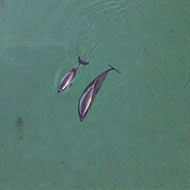
Scientists map the impact of marine traffic on porpoise populations.
Marine traffic could be limiting porpoises’ ability to feed and socialise effectively, according to new research.
The study by researchers at the University of Exeter found that harbour porpoises ‘buzz’ up to 45 per cent less when close to ships or boats.
Porpoises emit a distinct buzzing sound (a series of rapid clicks) when hunting or communicating.
In the study, researchers used underwater microphones to compare these sounds with vessel traffic in the narrow Little Belt Strait, Denmark.
Because harbour porpoises eat almost constantly and have a fast metabolism, researchers say the reduced activity could have significant consequences for the species.
They suggest that reducing boat speeds in the Little Belt Strait could therefore play an important role in protecting porpoises.
Study co-author Rachel Lennon said: “Our findings suggest chronic boat traffic may be limiting porpoises’ ability to feed and socialise effectively in important coastal habitats.”
“Porpoise activity dropped most significantly during summer daytime hours, when the Little Belt is busiest with vessels. In moments when vessels were not present, porpoise activity increased.
Co-lead author Shannon Merkle said: “We know from other studies that disruption to foraging can affect porpoises’ health, body condition and ultimately reproduction and survival
“While we did not directly assess the impact of boat traffic on porpoise populations, the disruption we found is likely to affect their ability to cope with other environmental stressors.
“It’s also important to note that porpoises cannot simply move elsewhere – as other areas may not have the needed density of prey that exists in the narrow part of the Little Belt.”
Because the Little Belt connects to the Baltic and North Seas, thousands of vessels pass through it each year. The population of porpoises known to use the strait is listed as ‘Endangered’, making threats to this population especially concerning.
Co-author Jonas Teilmann, professor at Aarhus University, said: “This study adds to the growing understanding of how underwater noise and the increasing vessel traffic affects our environment, and in particular a noise-sensitive species like the harbour porpoise.
“Our hope is that the results of this study will be used in future managing of the number of vessels, how fast they may move and their distribution in protected areas.”
The study is published in Marine Mammal Science.
Image (C) Jakob Højer Kristensen, Bionaut.


 Companies marketing medicines for small pets exempt from authorisation must submit their annual return to the Veterinary Medicines Directorate (VMD) by 30 November 2026.



