


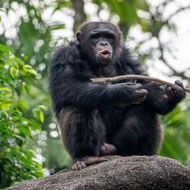
Study suggests the ability to pretend likely dates back six million years.
Pretend play is thought to be a uniquely human experience, and one that is crucial to our development.
From turning cardboard boxes into rockets to hosting fancy tea parties, this kind of play lets children explore the world around them safely and creatively.
But new research from John Hopkins University suggests humans may not be alone in this ability. For the first time, scientists have shown that apes can also use their imagination and play pretend.
Researchers created three experiments resembling a child’s tea party to test Kanzi, a 43-year-old bonobo living in captivity.
Kanzi, who can respond to verbal prompts by pointing, engaged with cups of imaginary juice and bowls of pretend grapes, turning long-held assumptions about animal abilities on their head.
In one experiment, the researchers placed two transparent empty cups on a table with an empty pitcher. They then pretended to pour “juice” into both cups, and emptied the juice from one cup, giving it a shake to show it was empty.
When Kanzi was asked where the juice was, he consistently pointed to the correct cup, even after the researchers changed the cup’s location.
In another experiment, the team placed a cup of real juice next to the pretend juice. When asked what he’d like, Kanzi pointed at the real juice almost every time. A third similar experiment with grapes also produced similar results.
The findings, published in the journal Science, suggest that the ability to understand pretend objects likely dates back to our common evolutionary ancestors, some six to nine million years ago.
Study co-author Christopher Krupenye, a Johns Hopkins assistant professor in the Department of Psychological and Brain Sciences, said: "Imagination has long been seen as a critical element of what it is to be human, but the idea that it may not be exclusive to our species is really transformative.
"Jane Goodall discovered that chimps make tools, and that led to a change in the definition of what it means to be human. And this, too, really invites us to reconsider what makes us special and what mental life is out there among other creatures."
Image (C) Shutterstock.com/Darcy Perkins.


 A nationwide roadshow offering free, personalised parasite risk assessments and flea and tick checks will be visiting popular dog events across the UK.



