


Orangutans successfully released back into the wild
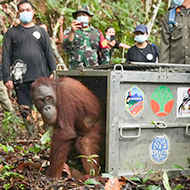
The release took place in the Mentatai Resort area of Bukit Baka Bukit Raya National Park.
Three orangutans have been successfully released into the Bukit Baka Bukit Raya National Park (TNBBBR) West Kalimantan, Indonesian Borneo, marking an important milestone for orangutan conservation.
The orangutans, named Badul, Korwas and Asoka, spent many years undergoing rescue and rehabilitation at the Yayasan Inisiasi Alam Rehabilitasi Indonesia (YIARI) rescue centre. They had been separated from their mothers at a young age due to captivity, the illegal wildlife trade or human inference, and lacked the vital life skills needed to survive in the wild.
As a result, the orangutans required long-term specialist care to prepare them for life in their natural habitat. The rehabilitation process focussed on restoring the natural behaviours necessary for survival, such as foraging, ranging and nest-building skills.
Before release, all three orangutans underwent a range of checks, including physical examinations, diagnostic tests, routine body weight monitoring, and identity verification through microchips.
YIARI chairman, Silverius Oscar Unggul, said: “Every orangutan successfully returned to the forest is the result of a long process: rescue, rehabilitation, and routine care by dedicated teams. The release of these three orangutans is not only good news for YIARI but also for the future of Indonesia’s biodiversity.”
The release took place in the Mentatai Resort area of Bukit Baka Bukit Raya National Park, where there is good forest cover, abundant food resources, and relatively low human pressure.
Persada Agussetia Sitepu, head of the TNBBBR, said: “The release of three Bornean orangutans in Bukit Baka Bukit Raya National Park is the result of a carefully planned process based on habitat suitability assessments, carrying capacity, and the readiness of rehabilitated animals. The Mentatai Resort area was chosen because it has good forest cover, adequate availability of natural food, and relatively low levels of human disturbance.”
Following their return to the wild, the orangutans will be closely monitored by YIARI and the national park teams to observe movement patterns, foraging behaviour, nest building and interactions with their environment.
Mr Sitepu added: “Orangutans play an important ecological role as seed dispersers. Their presence in TNBBBR is expected to strengthen forest ecosystem balance while supporting long-term conservation efforts in Bukit Baka Bukit Raya National Park.”
Image (C) BKSDA West Kalimantan, BTNBBBR and YIARA, partner of International Animal Rescue.


 Companies marketing medicines for small pets exempt from authorisation must submit their annual return to the Veterinary Medicines Directorate (VMD) by 30 November 2026.



