
Your data on MRCVSonline
The nature of the services provided by Vision Media means that we might obtain certain information about you.
Please read our Data Protection and Privacy Policy for details.

In addition, (with your consent) some parts of our website may store a 'cookie' in your browser for the purposes of
functionality or performance monitoring.
Click here to manage your settings.
If you would like to forward this story on to a friend, simply fill in the form below and click send.

Your friend's email:
Your email:
Your name:
 
 
Send Cancel

Rat tickling study reveals male-female differences in play 
"By understanding sex-specific preferences, we can design enrichment and handling practices that are truly beneficial for all animals” -- Dr Vincent Bombail.

The research has important implications for refining animal welfare practices.

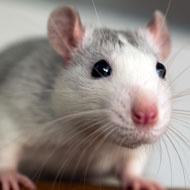
Tickling has been shown to produce a positive emotional response in laboratory rats. Now, new research, led by Scotland’s Rural College (SRUC), has revealed that juvenile male rats prefer a rougher style of play than females.

In the study, SRUC research fellow Dr Vincent Bombail and Professor Alistair Lawrence at the Animal Behaviour and Welfare Group explored how juvenile rats of both sexes respond to different styles of tickling.

Dr Bombail said: “Our results confirm that tickling is generally rewarding for both sexes, but males seem to prefer a rougher style of play, with more vigorous stimulation. Interestingly, female rats responded more positively when pinning was minimised, suggesting a need for sex-specific refinements in handling protocols.”

In the study, the team assessed whether reducing the intensity of tickling, particularly the use of “pinning” (placing rats on their back and tickling their belly), and introducing more flexible interactions, would reduce individual variation in emotional response.

The research has important implications for refining animal welfare practices, particularly for laboratory animals, and for understanding the biology of positive affective states (animal happiness).

Dr Bombail continued: “This isn’t just about tickling rats, it’s about using science to refine how we interact with animals in our care. By understanding sex-specific preferences, we can design enrichment and handling practices that are truly beneficial for all animals.”

The study, "Refinement of tickling protocols in male and female juvenile rats" is published in F1000Research.

Image (C) Bilanol/Shutterstock.com.

Become a member or log in to add this story to your CPD history

Equine Disease Surveillance report released for Q4 2025

News Story 1
 The latest Equine Disease Surveillance report has been released, with details on equine disease from Q4 of 2025.

The report, produced by Equine Infectious Disease Surveillance, includes advice on rule changes for equine influenza vaccination.

Statistics and maps detail recent outbreaks of equine herpes virus, equine influenza, equine strangles and equine grass sickness. A series of laboratory reports provides data on virology, bacteriology, parasitology and toxicosis.

This issue also features a case study of orthoflavivus-associated neurological disease in a horse in the UK. 

Click here for more...
News Shorts
RCVS members invited to question Council candidates

RCVS members have been invited to submit questions to candidates for this year's RCVS Council election.

With 15 candidates standing for three available positions, vets have been invited to submit a question of their choosing before voting starts. These questions will be collated, with each candidate answering one question of their choice.

It is recommended that members read the candidates' biographies and statements before submitting questions. One question per member can be submitted to vetvote26@rcvs.org.uk before Wednesday, 25 February 2026.

The RCVS Council election is due to start in March.

With only two candidates for two positions on the VN Council, there will be no VN Council elections this year. Meghan Conroy RVN and Lauren Hargrave RVN will begin their three year terms at RCVS' AGM in July.

