
Your data on MRCVSonline
The nature of the services provided by Vision Media means that we might obtain certain information about you.
Please read our Data Protection and Privacy Policy for details.

In addition, (with your consent) some parts of our website may store a 'cookie' in your browser for the purposes of
functionality or performance monitoring.
Click here to manage your settings.
If you would like to forward this story on to a friend, simply fill in the form below and click send.

Your friend's email:
Your email:
Your name:
 
 
Send Cancel

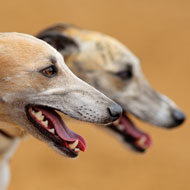
Greyhound Board announces change to vaccination guidance
"With the shift to L4 taking place nationwide, we expect that it will be increasingly difficult to source the L2 vaccine" - GBGB.

"It is vital we offer our greyhounds the broadest possible protection" - GBUK 

The Greyhound Board of Great Britain (GBGB) has published new vaccination guidance, with all greyhounds registered from 1 January, 2027 required to have the L4 leptospirosis vaccination, rather than L2.

The change comes in response to the reduced availability of the L2 Leptospirosis vaccine across the UK, and aims to support best biosecurity practice across the racing greyhound population. 

GBGB veterinary director Simon Gower, said “While rare, Leptospirosis is a serious infectious disease that can affect both dogs and humans, so it is vital that we offer our greyhounds the broadest possible protection.

“Many veterinarians are already opting to use the L4 vaccine, which protects against four Leptospira serovars rather than two. With the shift to L4 taking place nationwide, we expect that it will be increasingly difficult to source the L2 vaccine, so we strongly advise that trainers and track vets begin transitioning where they can ahead of the upcoming Rule change”.

Image (C) EcoPrint/Shutterstock.com

Become a member or log in to add this story to your CPD history

Defra shares new Sanitary and Phytosanitary guidance

News Story 1
 Defra has published guidance for the vet sector ahead of a proposed UK-EU Sanitary and Phytosanitary agreement.

The agreement, which will change the movement and trade of animals and related products, could see reductions in checks, paperwork and certification. As well as describing regulatory developments, the advice highlights the importance of animal ID, registration and traceability in disease control and other compliance arrangements.

The guidance can be found here. More detail is expected as negotiations progress. 

Click here for more...
News Shorts
Lords Committee opens Pet Parasite Medication inquiry

The House of Lords Environment and Climate Change Committee will launch its inquiry into Pet Parasite Medication (PPM) on Wednesday (3 June).

Focusing on treatments containing fipronil and imidacloprid, the inquiry will seek to understand distribution pathways and the impacts of PPM use and non-use on biodiversity and human health. It will also cover current regulation, monitoring, and the potential implications for pets and their owners.

The committee will hear evidence from environmental non-governmental organisations and research institutes. The public can follow the proceedings live on Parliament TV or in person in the Palace of Westminster.

