


Kittens rescued from boiling water pipes
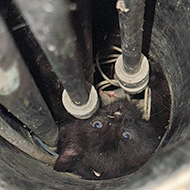
Kitten Barb found herself stuck in the pipe with her brother, Bill.
Cats Protection Cornwall are currently providing round-the-clock care to a pair of kittens rescued from boiling water pipes.
Five-week-old ‘Bill and Barb’ were due to be collected with their mother from a garden in Truro as part of ongoing work by Cats Protection to neuter a feral colony.
The kittens were sheltering in a shed when the charity arrived. But unbeknown to them, there was a pipe in the back corner with water heating pipes running through it.
Startled by the arrival, the kittens shot down the pipe and became tangled in some cables.
Cat’s Protection’s Jasmine Nevitte managed to rescue the first kitten, Barb. But Bill had managed to enter the pipe head-first and got himself stuck.
With no quick way to cool the pipes down, time was of the essence to rescue the young cat before he developed serious burns or died.
Jasmine said: “I could just about reach Bill’s back legs but the pipes were so hot I couldn't keep my arm down the outer pipe for very long. As time went on we got increasingly worried that the kitten was going to die from the temperature of the pipes resting on his tiny body and neck.”
After some quick thinking, Jasmine donned some insulated work gloves and a soft-shell jacket, which protected her enough to pull the pipes up and away from the kitten.
“I managed to keep my arm down the pipe long enough to get a grip on Bill’s back-end and release his head from under the pipe. I could then untangle his legs from the cables and pull him up,” she said.
“We took both kittens straight to the vets and amazingly Barb didn’t have any significant burns. Unfortunately, Bill’s little bottom was more badly burnt than we initially thought, and he will need close monitoring, daily bathing and is on antibiotics and pain relief.
“Although understandably shaken up from their ordeal, both kittens are doing well and behaving like typical, playful kittens. They are gradually adjusting to life with indoor comforts and getting used to humans.”
The kittens will now be cared for by Cats Protection and receive gentle socialisation until they are old enough to be rehomed.
Images (C) Cats Protection.


 Eligible members of BEVA will be able to vote for their Council team until Monday, 17 August 2026. Members will have received an election email on 17 July.



