


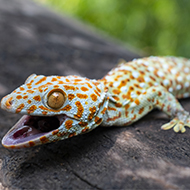
The finding could provide new insights about how animals perceive sound.
US scientists have discovered a hidden sensory ability in geckos that calls into question established ideas about how animals hear.
Biologists at the University of Maryland found that geckos use the saccule, a part of their inner ear traditionally associated with balance, to detect low-frequency vibrations. This mechanism, a special “sixth sense”, complements the geckos' regular hearing and how they sense their environment.
The team believes this previously unrecognised hearing mechanism may also be present in other reptiles, challenging previously established beliefs about how animal sensory systems evolved.
Catherine Carr, a distinguished university professor of biology at UMD, explained: "The ear, as we know it, hears airborne sound. But this ancient inner pathway, typically linked to balance, helps geckos detect vibrations that travel through mediums like the ground or water.
"This pathway exists in amphibians and fish, and now it's proven to be preserved in lizards as well. Our findings shed light on how the auditory system evolved from what you see in fish to what you see in land animals including humans."
The saccule can sense subtle vibrations between 50 and 200 Hz – far less than geckos normally hear through their ears.
Scientists say this demonstrates how the saccule functions as a distinct yet complementary function to the geckos' regular hearing system. Although geckos can hear airborne sounds, many other reptiles lack this ability.
Study lead Dawei Han, a postdoctoral researcher and former graduate student at UMD, believes the identification of the saccule's role in gecko hearing could provide new insights into how animals considered to have limited hearing abilities behave and communicate.
"A lot of snakes and lizards were thought to be 'mute' or 'deaf' in the sense that they do not vocalize sounds or hear sounds well," said Han. "But it turns out they could potentially be communicating via vibrational signals using this sensory pathway instead, which really changes the way scientists have thought about animal perception overall."
The study, Auditory pathway for detection of vibration in the tokay gecko, is published in Current Biology.
Image (C) Shutterstock.


 A nationwide roadshow offering free, personalised parasite risk assessments and flea and tick checks will be visiting popular dog events across the UK.



