


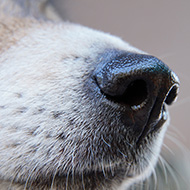
The dogs used their incredible sense of smell to identify chronic wasting disease in faeces.
Researchers in the US have trained pet dogs to identify the odour of chronic wasting disease (CWD).
The proof-of-concept investigation, led by the University of Pennsylvania's School of Veterinary Medicine, suggests dogs could be helpful in the fight against this highly contagious and fatal disease of deer.
CWD has been present in the state of Pennsylvania since 2012. A significant issue with curtailing its spread is that symptoms often lay dormant in an affected deer for many months or even years, during which the seemingly healthy animal can shed infectious proteins into the environment.
Currently, there is no cure or effective treatment for CWD, which leads to weight loss and neurological issues, such as stumbling and drooling. Diagnosis can only be performed following death by assessing an affected animal's brain.
Researchers have attempted to take biopsies from potentially-infected live animals, but this is highly stressful for the deer and collecting the samples can pose a physical and logistical challenge.
To find a new way to detect the disease, researchers trained dogs at the Penn Vet Working Dog Center to identify the odour of CWD in deer faeces samples that were CWD-positive and CWD not-detected. Through this method, the dogs were able to alert their handlers to the presence of the disease both in the laboratory and in the field.
Study lead Amritha Mallikarjun explained: “We were already quite certain that the dogs could detect the volatile organic compounds released by chronic wasting disease in faeces. Not only did we show this was possible, but we also answered a second, more interesting question, which is, Can they detect the disease in a simulated field setting, as they would if we were using the dogs to find the disease in the landscape of a forest or on a deer farm?”
Interestingly, the dogs could, and they did so with enough precision to suggest that detection dogs would be an effective strategy in the fight against CWD.
Cynthia Otto, the senior author of the study and director of the Working Dog Center, said: “We learned a lot through the study and are now set up well to continue refining our training.”
Amritha Mallikarjun, a postdoctoral fellow in the University of Pennsylvania School of Veterinary Medicine, added: “Given the amount of time that we trained these dogs and the novel environment, not to mention the fact that these are pet dogs and not trained search dogs, our results are promising.
"As we move forward and work with dogs that are specifically trained to search in a field setting and devote their entire lives to detecting this odour, they are going to do an even better job.”


 Eligible members of BEVA will be able to vote for their Council team until Monday, 17 August 2026. Members will have received an election email on 17 July.



