


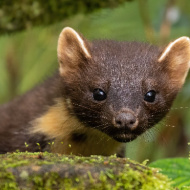
The species is previously only thought to have survived mostly in the North of England.
Pine martens are established and successfully breeding in the south of England, according to conservationists.
A long-term study involving hidden cameras has captured the rare species playing and exploring in the New Forest National Park. Previously it was thought they had mostly survived in the North of England.
Once widespread across the UK, pine martens are in drastic decline owing to habitat loss and human activity. Only a small and fragmented population remains in Northern England, Scotland and regions of Wales.
The first pine marten in the New Forest was sighted by the New Forest Badger Group in 1993. Since then, conservationists have recorded a number of other sightings, including pine martens captured on hidden cameras set up to monitor other species.
With proof that pine martens have established in the New Forest, a team from Forestry England, Hampshire & Isle of Wight Wildlife Trust, and Wild New Forest now aim to determine the population's size and reproductive success. Additionally, they hope to locate the various forest habitats and regions where they are settling.
Leanne Sargeant, senior ecologist at Forestry England, said: “It is not often that we are able to talk about wildlife returning to landscapes and re-establishing their populations, so this is a really fascinating development to study. The New Forest is a unique landscape and a haven for wildlife, and through this work we hope to learn just what makes it such a good habitat for returning pine martens.”
Pine martens are a member of the weasel family, preferring well-wooded areas with plenty of cover and largely feed on small rodents, birds, insects and fruit.
Every pine marten is chestnut brown in colour, but each has a uniquely shaped bib – a pale yellow section of fur on its chin and throat. This makes it possible to identify and record every individual, and observing their interactions means the team can also identify family groups.


 Companies marketing medicines for small pets exempt from authorisation must submit their annual return to the Veterinary Medicines Directorate (VMD) by 30 November 2026.



