


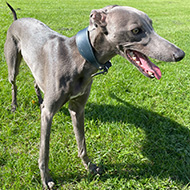
Interesting case highlights the need for repeat sampling in some patients.
Internal medicine specialists were faced with a 'diagnostic dilemma' when a young whippet presented with chronic cough, weight loss and reduced energy.
Two-year-old Eagle was referred to Davies Veterinary Specialists, where initial investigations resulted in a suspected diagnosis of an aerodigestive disorder, such as IBD, that could be contributing to the coughing.
While awaiting the outcome of a bronchoalveolar lavage (BAL), the internal medicine team prescribed Eagle reflux/IBD medication, an exclusion diet and vitamin B12 for gut support. They also administered a precautionary de-wormer to treat lungworm, despite a negative test, and any Giardia that may have been contributing to his loose faeces.
Unfortunately, Eagle did not respond as well as the team had hoped to the initial treatment, and the outcome of the BAL was non-diagnostic, leaving them with no choice but to go back to the drawing board.
Polly Frowde, an internal medicine specialist at Davies, explained: “Although Eagle’s signs initially improved a little on the medication, they did not completely resolve.
“He continued to suffer frequent coughing fits and weight loss, so we made the decision to conduct a bronchoscopy to perform a ‘targeted’ BAL. We also discussed combining this with an endoscopy for his possible enteropathy, but it was decided to stage investigations.”
She continued: “The bronchoscopy revealed yellow mucus in the airways and mild tracheal collapse. We used a scope for the lung wash for further reach this time (targeting where the main changes were on CT).
“Initial in-house analysis of the samples showed eosinophilic inflammation – raising suspicion for an immune-mediated form of inflammatory lung disease called eosinophilic bronchopneumopathy. Parasites can also cause this inflammation, but, as he had already been thoroughly wormed, seemed unlikely.”
The final laboratory findings supported the diagnosis of eosinophilic inflammation consistent with eosinophilic bronchopneumopathy. Eagle was prescribed oral steroids (prednisolone), to which he responded extremely well.
To avoid disease relapse, steroids are often tapered to a ‘maintenance dose’ and administered via an inhaler to minimise side effects in the longer term.
Polly continued: “This was an interesting case given that the initial BAL was non-diagnostic, and it was very rewarding to finally get to the bottom of things for poor Eagle.
“It highlighted the need for repeat sampling in some patients and the diagnostic dilemmas when faced with possible lungworm infection since certain procedures such as bronchoscopy can be riskier if the parasite is causing problems with coagulation. A ‘targeted’ lung wash can reach more distant areas of the lung. It is likely that Eagle also has a chronic enteropathy, which may be benefiting from the steroids too.”
Eagle is said to have made a great recovery since his diagnosis, and the team have been able to successfully taper down the steroids so they are now only being administered via an inhaler.
Owner Kathryn Stratton said: “It is a huge relief to finally have positive improvement from Eagle. After months of sleepless nights from his consistent coughing and vomiting, he is back to running around, playing and misbehaving!”
Image (C) Davies Veterinary Specialists.


 Eligible members of BEVA will be able to vote for their Council team until Monday, 17 August 2026. Members will have received an election email on 17 July.



