


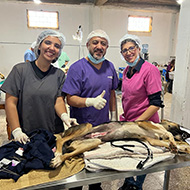
The participants included local vets and those from various veterinary agencies.
Award-winning vet and Mayhew director Dr Abdul-Jalil Mohammadzai has been delivering reproductive surgery training to professionals across the capital city of Algeria.
Dr Mohammadzai - or 'Dr Mo' as he is more affectionately known - provided 10 days of practical training in humane animal handling and restraint, asepsis, anaesthesia and analgesia to more than 30 vets in Algiers.
Participants included local vets and those from various veterinary agencies, including the Institut Pasteur, the Algerian Veterinary Inspectorate, and the Veterinary Faculty of the University Saad Dahlab Blida.
Drawing on his involvement in the first-ever dog population survey in Kabul, Afghanistan, Dr Mo also shared insights on rabies prevention, management and control with the Algiers Municipality and local charity in Algiers, BCHE (Billy for Compassion, Humanity and Empathy).
Dr Mo said: “This will be one the most rewarding training experiences I can deliver to vets in Algiers. It will not only enable participants to enhance their veterinary skills in key important surgical procedures but will also serve as a foundation to help disease prevention, management, protection and the surveillance of diseases like rabies.
“In much the same way as the work, I was humbled and proud to have delivered in Kabul was designed to support rabies prevention and humane dog population management. I hope the training I deliver to the vets in Algiers can be built upon to influence the attitudes of their local communities.”
With branches in Afghanistan and Georgia, Mayhew's overseas work provides sustainable solutions to roaming dog populations and disease control through vaccination programmes and training the local veterinary profession.
Thanks to the efforts of Dr Mo and the Mayhew team, there have been no recorded canine-mediated rabies deaths in humans in Kabul for the past 19 months, with more than 95,000 dogs vaccinated. There have not been any confirmed positive cases of rabies in dogs in the city since April 2021.
Image (C) Mayhew.


 Companies marketing medicines for small pets exempt from authorisation must submit their annual return to the Veterinary Medicines Directorate (VMD) by 30 November 2026.



