


Dogs shed tears of joy when reunited with owners, research finds
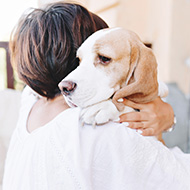
Dogs' tears might play a pivotal role in eliciting nurturing behaviour from their owners.
A new study by researchers in Japan suggests that dogs secrete tears when they are reunited with their owners.
Scientists analysed tear volume in dogs before and after reunions with owners and familiar non-owners and found that crying appears to be associated with oxytocin, the bonding hormone.
The team writes: ‘This is the first report on positive emotion stimulating tear secretion in a non-human animal, and oxytocin functioning in tear secretion.’
Writing in Current Biology, researchers note how eye contact plays a pivotal role in attachment behaviour in dogs, with eye contact between dogs and humans eliciting human caregiving behaviour. It is also thought that dogs’ tears during reunions with owners can facilitate human caregiving, a phenomenon which has similarly been reported in human children.
In the study, researchers measured the tear volumes of dogs in their normal home environment with their owner present (the baseline volume), using Schirmer’s tear test.
The team then measured the volume within the first five minutes of a reunion with the owners after five to seven hours of separation. Their analysis revealed that tear volume significantly increased during the reunions.
In a second experiment, the team compared tear volumes before and after reunions with owners and familiar non-owners and found that tear volume during a reunion with the owner was significantly greater than the baseline tear volume.
Next, to assess the role of oxytocin, the team dropped a solution containing the hormone onto the surface of dogs’ eyes and found that tear volume significantly increased – something that was not seen with the control, oxytocin-free, solution.
Finally, the team asked human participants to rate their impressions of dogs’ faces with or without artificial tears in terms of how much they wanted to care for them. The participants ranked the dog photos with artificial tears markedly higher than the normal tearless dog photos.
The authors conclude: ‘Unlike any other animals, dogs have evolved or have been domesticated through communication with humans and have gained high-level communication abilities with humans using eye contact.
‘Through this process, their tears might play a role in eliciting protective behaviour or nurturing behaviour from their owners, resulting in the deepening of mutual relationships and further leading to interspecies bonding.’


 Eligible members of BEVA will be able to vote for their Council team until Monday, 17 August 2026. Members will have received an election email on 17 July.



