
Your data on MRCVSonline
The nature of the services provided by Vision Media means that we might obtain certain information about you.
Please read our Data Protection and Privacy Policy for details.

In addition, (with your consent) some parts of our website may store a 'cookie' in your browser for the purposes of
functionality or performance monitoring.
Click here to manage your settings.
If you would like to forward this story on to a friend, simply fill in the form below and click send.

Your friend's email:
Your email:
Your name:
 
 
Send Cancel

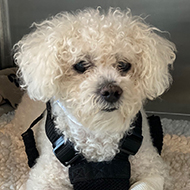
Bichon frise receives successful meningioma surgery
"Meningiomas are the most common brain tumours in dogs" - Alex Forward.

Bella Rose has made a good recovery following tumour removal.

A bichon frise has a new lease of life after veterinary specialists operated on a brain tumour which was causing her loss of balance and movement.

Andrea Wadey, owner of 10-year-old Bella Rose, noticed that Bella had become unsteady on her legs, was falling over frequently, and has started to toilet in the house.

When Bella was taken for a veterinary check, she was swiftly referred to  Davies Veterinary Specialists for urgent neurology care. 

Neurologist at Davies, Alex Forward, performed an MRI scan on Bella. The results revealed a large brain tumour on her cerebellum, which is vital for coordination and movement. 

Mr Forward explained: “We spoke to Bella’s owner about the options and after careful consideration she  elected for surgery to remove the tumour.

“We had to remove a section of the skull to access the back of her brain to enable us to excise as much of the mass as possible. Bella was understandably a bit wobbly after surgery but recovered well and was able to go home seven days later.

“The tumour was analysed and returned as a meningioma, which is the most common type of brain tumour in dogs. 

“These are also one of the most common brain tumours found in people and arise from cells in the meninges, which are layers that line the surface of the brain.”

Bella has made a good recovery from her surgery, and is reportedly far more interactive and excited. 

Mr Forward added: “She has also started going to the toilet outside again and is otherwise well in herself. Our fingers are firmly crossed that she will continue to do well.”


Images (C) Davies Veterinary Specialists

Become a member or log in to add this story to your CPD history

Equine Disease Surveillance report released for Q4 2025

News Story 1
 The latest Equine Disease Surveillance report has been released, with details on equine disease from Q4 of 2025.

The report, produced by Equine Infectious Disease Surveillance, includes advice on rule changes for equine influenza vaccination.

Statistics and maps detail recent outbreaks of equine herpes virus, equine influenza, equine strangles and equine grass sickness. A series of laboratory reports provides data on virology, bacteriology, parasitology and toxicosis.

This issue also features a case study of orthoflavivus-associated neurological disease in a horse in the UK. 

Click here for more...
News Shorts
RCVS annual renewal fee for vets due

RCVS' annual renewal fee for veterinary surgeons is now due. Vets must pay their renewal fee before Wednesday, 1 April 2026.

This year's standard annual fee has increased to 431 from last year's 418. This is an approximately three per cent increase, as approved by RCVS Council and the Privy Council.

Tshidi Gardner, RCVS treasurer, said: "The small fee increase will be used to help deliver both our everyday activities and our new ambitious Strategic Plan, which includes aims such as achieving new legislation, reviewing the Codes of Professional Conduct and supporting guidance, and continuing to support the professions through activities such as the Mind Matters Initiative, RCVS Academy and career development."

A full breakdown of the new fees is on the RCVS website. Information about tax relief is available on the UK government website.


