


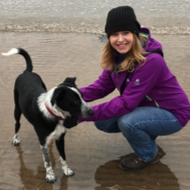
Dr Jessica Martin recognised for work with farm and laboratory animals.
The Universities Federation for Animal Welfare (UFAW) has awarded Dr Jessica Martin, a scientist at the Roslin Institute and the Royal (Dick) School of Veterinary Studies, the Early Career Animal Welfare Researcher of the Year Award.
The award recognises Dr Martin's significant contributions to animal welfare through research, education, legislative and institutional policy, and real-world impact.
Dr Martin, who is a senior lecturer in physiology and animal welfare, was the co-inventor of Livetec Nex – a novel technology that improves efficiency and welfare outcomes for the killing of individual birds on-farm. In 2020, her design was named “New Product of the Year” by Poultry Business Magazine and was widely adopted by the industry in association with its Red Tractor compliance.
Dr Martin was the deputy leader of an international research team that conducted a groundbreaking welfare assessment of Low Atmospheric Pressure Stunning (LAPS) in poultry. She was also instrumental in a successful application to the European Commission to allow the use of LAPS in poultry, which resulted in its inclusion in EU law in 2018.
Commenting on her achievement, Dr Martin said: “I am delighted to have received this award and would like to thank UFAW and my nominators for their support and encouragement. All animals deserve a life worth living and a death free of pain and anxiety.
"Research in the area of end of life ensures we can minimise animal suffering both physically and mentally, protecting all animals that humans have responsibility e.g. livestock and animals used for research purposes.”
The UFAW prize recognises the achievements of early-career scientists who have made significant contributions to improving animal welfare.
This year it was jointly awarded to Dr Martin and Dr Nienke van Staaveren of the University of Guelph, Canada, in recognition of their impactful work and breadth of experience across a variety of species and topics.
The winners will receive their awards and deliver a presentation about their work at UFAW’s International Conference in Edinburgh in June.
Image (C) University of Edinburgh.


 Companies marketing medicines for small pets exempt from authorisation must submit their annual return to the Veterinary Medicines Directorate (VMD) by 30 November 2026.



