
Your data on MRCVSonline
The nature of the services provided by Vision Media means that we might obtain certain information about you.
Please read our Data Protection and Privacy Policy for details.

In addition, (with your consent) some parts of our website may store a 'cookie' in your browser for the purposes of
functionality or performance monitoring.
Click here to manage your settings.
If you would like to forward this story on to a friend, simply fill in the form below and click send.

Your friend's email:
Your email:
Your name:
 
 
Send Cancel

PDSA vets warn against stick games
"We were stunned to discover that the stick from an innocent game of fetch had caused so much damage to poor Dre without us realising" - Danielle Knight, Dre's owner.

“We'd encourage pet owners to use safer alternatives to sticks.”

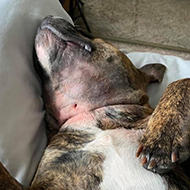
National veterinary charity PDSA is warning dog owners of the dangers of stick-throwing games for dogs, after a Staffordshire bull terrier needed emergency surgery when a stick pierced his mouth during a game of fetch.

Danielle Knight, who owns one year old Dre, heard him yelp in pain and noticed blood coming from his mouth, which stopped fairly quickly. 

However, the next day, Dre's tongue and neck had swollen significantly, so Danielle called the PDSA for help, who admitted Dre to the hospital straight away. 

Suzy Shuttleworth, PDSA veterinary surgeon, said: “Once Dre had been given pain killers and put under anaesthetic, we discovered a large area of swelling under Dre’s jaw and a hole under his tongue. We were shocked to discover a 1-inch piece of stick lodged under his tongue!”

PSDA carried out surgery to remove the stick, and Dre was able to return home to recover in time for Christmas with antibiotics, pain relief and close monitoring.

Suzy warned pet owners: “We love to see people exercising their pets, but we’d encourage pet owners to use safer alternatives to sticks which you can buy from most supermarkets or pet shops.”

Dre's owner Danielle added: “I’d encourage all pet owners to keep sticks well away from pets to avoid injuries. Had it not been for PDSA, we could have lost Dre. 

“We had only adopted him this year and would have struggled to afford the cost of surgery, but thankfully, we were eligible for PDSA’s services. We cannot thank the team at Nottingham PDSA enough.”

Image (C) PDSA

Become a member or log in to add this story to your CPD history

Equine Disease Surveillance report released for Q4 2025

News Story 1
 The latest Equine Disease Surveillance report has been released, with details on equine disease from Q4 of 2025.

The report, produced by Equine Infectious Disease Surveillance, includes advice on rule changes for equine influenza vaccination.

Statistics and maps detail recent outbreaks of equine herpes virus, equine influenza, equine strangles and equine grass sickness. A series of laboratory reports provides data on virology, bacteriology, parasitology and toxicosis.

This issue also features a case study of orthoflavivus-associated neurological disease in a horse in the UK. 

Click here for more...
News Shorts
RCVS annual renewal fee for vets due

RCVS' annual renewal fee for veterinary surgeons is now due. Vets must pay their renewal fee before Wednesday, 1 April 2026.

This year's standard annual fee has increased to 431 from last year's 418. This is an approximately three per cent increase, as approved by RCVS Council and the Privy Council.

Tshidi Gardner, RCVS treasurer, said: "The small fee increase will be used to help deliver both our everyday activities and our new ambitious Strategic Plan, which includes aims such as achieving new legislation, reviewing the Codes of Professional Conduct and supporting guidance, and continuing to support the professions through activities such as the Mind Matters Initiative, RCVS Academy and career development."

A full breakdown of the new fees is on the RCVS website. Information about tax relief is available on the UK government website.


