


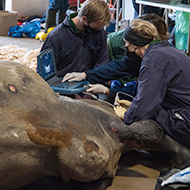
Whipsnade Zoo has allowed Clara's tissue to be used for veterinary research and conservation projects.
A rhinoceros at ZSL Whipsnade Zoo is helping her species to live on after her death, after tissue samples were taken at her post-mortem to be used for veterinary research and conservation projects.
Clara the 40 year old Southern white rhino was sadly put to sleep on Wednesday 10 November, after examination by veterinary surgeons discovered that her condition was worsening, and would not be treatable.
Clara's post-mortem not only allowed the Zoo to gain more knowledge of her condition, but it also meant that over 70 different tissue samples could be taken for future conservation and understanding of her species.
Dr Spiro, ZSL's wildlife veterinary pathologist, said: “With the future of rhinos in such jeopardy, ZSL’s own DNA bank will keep a copy of Clara’s genome to store indefinitely, and the specialist programme The Rhino Fertility Project at the University of Oxford is working to develop ways to grow immature eggs from Clara's ovary and generate mature eggs from them so that they can potentially be fertilised to produce white rhino embryos in the future.
“Meanwhile, a skin sample from Clara’s ear will be treated and cryopreserved by partner organisation Nature’s SAFE, a living biobank, who store cell lines from endangered animal species. Clara’s cells will be used to create an immortal cell line, so that her cells can be used to study white rhino biology and genetics for years to come.”
The Wellcome Sanger Institute will also be using Clara's tissue to investigate the genetics of ageing, and Dr Spiro commented: “By studying her cells to see if they have mutated, scientists may be able to see if rhinos age the same way as humans age, whether they are better or worse at resisting ageing, and use that information to better understand the development of cancers and heart disease.
“Even in death, there can be life. While it is very sad for all of us that Clara’s gone, her tissues will influence the way we look after and protect this incredible species in the wild for years to come.
“In that sense, Clara will be part of the future conservation of this incredible species in a way that will live on forever.”
Image (C) ZSL Whipsnade Zoo.


 Companies marketing medicines for small pets exempt from authorisation must submit their annual return to the Veterinary Medicines Directorate (VMD) by 30 November 2026.



