


Vet warns of 'screw tail' dangers
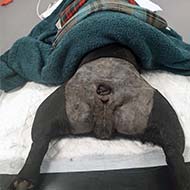
"Unfortunately, 'screw tail' is an issue that is common in these breeds." - Bart Hendrickx.
A vet at West Midlands Referrals (WMR) has warned pet owners about the dangers of chronic pain and infection caused by screw tail – a condition which affects English and French bulldogs and pugs.
Screw tail, also known as 'ingrown tail' and 'corkscrew tail', is a genetic abnormality, where fused tail vertebrae form a spiral curvature, which can cause excessive skin folds, tail immobility, and anal obstruction.
Bart Hendrickx, senior veterinary surgeon at West Midlands Veterinary Referrals in Staffordshire, spoke out about the problem after performing a tail amputation on a French bulldog.
Bart said: “Screw tail is a developmental issue where the dog’s tail is formed into a corkscrew that twists the overlying skin into pockets and recesses.
“This moist, warm area is then a perfect environment for growth of microbes, which then lead to chronic infection causing significant discomfort.
“The only way to deal with this is to remove the warm damp recesses and that means the amputation of the cork-screw tail and with it the infected skin folds.
“There is no other way to solve the problem but, fortunately, there are no adverse consequences of removing the tail, which in these breeds is stumpy and essentially immobile anyway.
“Unfortunately, though, ‘screw tail’ is an issue that is common in these breeds and we are seeing an increase in these congenital tail malformations and deformities.”
Bart spoke up about the condition after operating on Pippi, the French bulldog – who had a screw tail malformation with secondary pyoderma, and was referred to WMR for surgery.
Pippi's operation lasted for 30 minutes, and she has since made a full recovery.


 Eligible members of BEVA will be able to vote for their Council team until Monday, 17 August 2026. Members will have received an election email on 17 July.



