


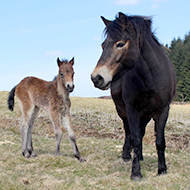
The endangered breed is being studied by researchers at Glasgow University.
The University of Glasgow has added a herd of Exmoor ponies to its Cochno Farm.
Studied and monitored by researchers at the university, the ponies are the subject of Debbie Davy's PhD, which aims to investigate genetic variation to improve breeding management practices, and to understand the impact of pony grazing on habitat quality.
Davy's PhD is funded by the Exmoor Pony Society as a part of its centenary celebrations. Alongside this, the ponies will be used for other projects, including Professor Marcello Riggio's research on microbial communities and animal health.
The ancient breed, which was recorded in the 1086 AD Domesday book, is considered to be Britain's most ancient pony, is now listed as endangered by the Rare Breeds Survival Trust.
After a severe genetic bottleneck after the Second World War, the current population of Exmoor ponies is descended solely from fewer than fifty foundation animals.
Introduced to the farm initially in November 2020, the ponies at Cochno farm consists of four mares, one stallion, and three foals, two of which were born at Cochno. Both of the new ponies are reportedly developing well, and are valuable additions to the endangered population.
Commenting on the arrival of the rare ponies, PhD student Debbie Davy said: “Since their arrival the ponies have been attracting lots of positive attention from Cochno visitors, and the herd is now being used in other student projects.
“It’s such a pleasure to work with these important by endangered animals and I hope our work here will help us to gain a better understanding of this important breed.”
Images (C) Lea Gilbert, University of Glasgow MSc student who is working with the ponies


 A nationwide roadshow offering free, personalised parasite risk assessments and flea and tick checks will be visiting popular dog events across the UK.



