


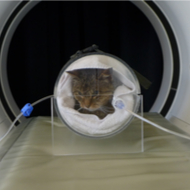
Misha the cat is now in remission from plasma cell cancer.
Misha the 14-year-old shorthair cat is in remission from plasma cell cancer after care from several teams at the Royal (Dick) School of Veterinary Studies.
The cancer was discovered when preparation for dental work revealed that there was a change in Misha's liver health, and from there, it was discovered that he had cancer affecting several of his organs.
After further testing, it was discovered that Misha had multicentric plasma cell neoplasia, which had caused tumours in his spleen, liver and on a lymph node.
Collaborating on Misha's treatment, teams from feline medicine, surgery, intensive care, pathology, oncology, and dentistry were able to remove the cat's spleen and the tumours on his lymph node, and used chemotherapy to treat the tumours on his liver.
Four months post-treatment, scans of Misha have suggested his condition to be significantly better. He has no visible lesions on his organs, and his enzyme levels have improved. Still recovering at home, Misha is receiving ongoing low-dose chemotherapy.
Misha's owner, and radiologist at the Dick Vet, Tobias Schwarz, commented: “I’m very happy that Misha is now doing so well. His illness highlights the importance of regular health checks to help spot issues that may otherwise be undiagnosed, and the benefit of treating animals early on their illness, to improve their chances of recovery.
“With advances in oncology, successful treatment of cancer in animals is becoming more common, and consequently other important diseases, such as dental disorders, need to be considered for treatment as well, if we want to improve the health and welfare of our animals.”
Image (C) The Royal (Dick) School of Veterinary Studies


 Eligible members of BEVA will be able to vote for their Council team until Monday, 17 August 2026. Members will have received an election email on 17 July.



