


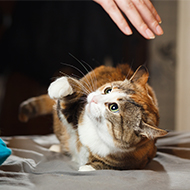
The simple guidelines are intended to keep cats comfortable during interactions.
Researchers from Nottingham Trent University have developed guidelines for human interactions with cats to improve the wellbeing and comfort of felines during these interactions.
The guidelines are simple and follow the acronym 'CAT'. They encourage the public to provide the cat with control [C], pay attention to the cat's behaviour [A], and think about what part of the cat they are touching [T].
According the Dr Lauren Finka, lead researcher on the study surrounding cat behaviour in human interactions, published in Frontiers in Veterinary Science, providing a cat with control in an interaction is all about offering them choice, allowing the cat to move away if desired, and offering their hand first to see if the cat withes to interact before stroking.
The guidelines suggest that paying attention to the cat's behaviour is also key in creating a comfortable interaction for the cat. Dr Finka suggests that owners look out for the cat turning their head, rotating or flattening ears, shaping their head, or swishing their tail.
Dr Finka also suggests to cat owners that the best places to stroke a cat are usually at the base of their ears, around their cheeks, and under their chin - although all cats will have different preferences. She advises owners to pay attention to how their cat enjoys being interacted with.
Dr Fink commented on the guidelines: “These simple ‘CAT’ guidelines are designed to ensure that cats are never overwhelmed during petting and that people are being mindful of where, how and how much they are stroking cats.
“They also encourage people to look out for some key subtle behavioural signs of cat discomfort, and to respond accordingly to these, rather than waiting until the cat behaves aggressively before giving it a break.
“The guidelines are designed to be suitable for all cats because they encourage a flexible approach based on how the cat is responding in real time, ensuring that the interactions meet the needs and preferences of each individual.”
Battersea's feline welfare manager, JoAnna Puzzo, added: “Cats can be incredibly subtle when expressing their likes and dislikes, and as a result their behaviour can be misunderstood or ignored completely. By using these new simple yet effective ‘CAT’ guidelines, owners will be able to better understand how their cat is feeling and adapt how they interact together to ensure their pet is happy and relaxed.
“Collaborating with Dr Finka and the University has been an invaluable experience for Battersea. The study’s findings will be of great benefit to not only the cats in our care and the owners who look to us for pet care advice, but the millions of pet cats across the UK and beyond.”


 Eligible members of BEVA will be able to vote for their Council team until Monday, 17 August 2026. Members will have received an election email on 17 July.



