


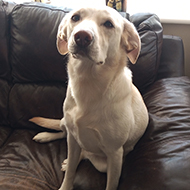
Labrador Nell is recovering well after surgery to remove malignant mass
Vets have carried out an intricate, life-saving operation on a Labrador to remove a cancerous mouth tumour.
Two-year-old Nell was presented to Paragon Veterinary Referrals in Wakefield with a lump on her upper jaw. A CT scan and biopsy revealed that it was a large, malignant mass that had grown unnoticed.
Soft tissue specialist Mickey Tivers said: “Our CT scan showed that the mass was invading the underlying bone but that it should be amenable to surgical removal and there was no evidence that the mass had spread elsewhere.
“What made the case more unusual was that the biopsy showed it was a malignant tumour and Nell was very young to have developed a malignant tumour in her mouth. We decided surgery was the best option so we could remove the mass plus wide margins around it to ensure we’d cut it all away.”
To remove the tumour and the surrounding tissue, Mickey needed to remove a considerable portion of Nell's upper jaw, including five teeth.
“Firstly, incisions were made through the gum and soft tissues of the roof of her mouth before we cut the bone in front and behind the tumour,” he said. “Another cut was made to join these two, just under her right eye, while a further cut was made through the bone of the roof of her mouth to free the section of bone.
“After removal of the tumour the hole was then closed by suturing the tissue of her lip to her hard palate. She’s certainly made a very good recovery and dogs do cope surprisingly well after this type of surgery and can function normally again very quickly.
“The surgery went very well. The mass had been completely removed and hopefully, this will be a cure for Nell."


 Eligible members of BEVA will be able to vote for their Council team until Monday, 17 August 2026. Members will have received an election email on 17 July.



