


Bio-detection dogs sniff out COVID-19 with 94 per cent accuracy
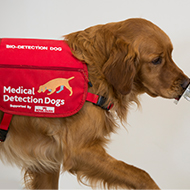
The dogs were trained to detect COVID-19 on clothing samples supplied by the NHS and members of the public.
Specially-trained dogs can quickly and non-invasively sniff out COVID-19 in people with up to 94 per cent accuracy, according to new research.
The study led by the London School of Hygiene & Tropical Medicine (LSHTM) and Durham University found that bio-detection dogs can identify the odour of COVID-19 in individuals that have no symptoms and those with two different strains of the disease.
Researchers say that while the study took place in a trial setting, the results could one day be replicated in real-world environments, such as airports.
Study leader Professor James Logan, head of the department of disease control at LSHTM, said: “The results of this study far exceeded my expectations. While the mass rollout of vaccines in the UK is a great success, it will take time to achieve the coverage levels needed for our lives to return to near normal."
In the study, dogs were trained by the charity Medical Detection Dogs to sniff out COVID-19 on clothing samples (masks, socks and t-shirts) supplied by members of the public and NHS staff. The samples were presented to the dogs, and the dogs were given a treat for correctly identifying a positive sample, or for correctly ignoring a negative sample.
Six dogs were then selected to participate in a double-blind trial, where the dog, technician and trainer were unaware of which samples were positive or negative. The highest performing dogs detected the odour of the virus in the samples with up to 94.3 per cent sensitivity (meaning a low risk of false-negative results) and up to 92 per cent specificity.
An accompanying mathematical model underlined the potential for these dogs to put to use in real-world settings, with preliminary work suggesting two dogs could screen 300 passengers per plane in around 30 minutes. Only people that are identified by the dogs would need a PCR test.
Dr Claire Guest, chief scientific officer at Medical Detection Dogs, said: “These fantastic results are further evidence that dogs are one of the most reliable biosensors for detecting the odour of human disease. Our robust study shows the huge potential for dogs to help in the fight against COVID-19.
“Knowing that we can harness the amazing power of a dog’s nose to detect COVID-19 quickly and non-invasively gives us hope for a return to a more normal way of life through safer travel and access to public places so that we can again socialise with family and friends.”
Researchers will now proceed to the next stage of the trial where they will assess whether the dogs can detect the virus in real-world settings. It is also hoped that the dogs could also serve as visual deterrents to reduce the number of passengers travelling with falsified COVID-19 negative certificates.


 Eligible members of BEVA will be able to vote for their Council team until Monday, 17 August 2026. Members will have received an election email on 17 July.



