


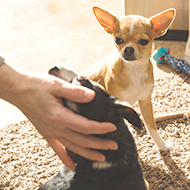
Researchers gauged dogs' reactions when owners gave attention to a perceived rival.
New research from the University of Auckland has bolstered theories that dogs act jealously when their owners give attention to another dog, even when that other dog is out-of-sight.
In the past surveys have shown that more than 80 per cent of dog owners report observing jealous behaviours from their dog, including vocalizations, agitated behaviour and lead-pulling, when they give attention to other dogs.
The new research, published in Psychological Science, used a highly realistic artificial dog to show that dogs exhibit these behaviours even when simply imagining a situation where their owner is interacting with a perceived rival dog.
In the experiment, 18 dogs were shown the fake-dog rival positioned next to their owner. Then a barrier was placed between the dog and the potential rival. Despite the rival being obscured from view, the dogs demonstrated great efforts to reach their owners when they appeared to stroke the rival fake dog behind the barrier.
The experiment was then repeated using a fleece cylinder, rather than an artificial dog. In this instance, the dogs were far less forceful in their efforts to get to their owner.
Amalia Bastos, lead author said: “These results support claims that dogs display jealous behaviour. They also provide the first evidence that dogs can mentally represent jealousy-inducing social interactions.
“Previous studies confounded jealous behaviour with play, interest, or aggression, because they never tested the dogs’ reactions to the owner and the social rival being present in the same room but not interacting.”
She continued: “There is still plenty of work to do to establish the extent of the similarities between the minds of humans and other animals, especially in terms of understanding the nature of nonhuman animals’ emotional experiences.
“It is too early to say whether dogs experience jealousy as we do, but it is now clear that they react to jealousy-inducing situations, even if these occur out-of-sight.”


 Eligible members of BEVA will be able to vote for their Council team until Monday, 17 August 2026. Members will have received an election email on 17 July.



