


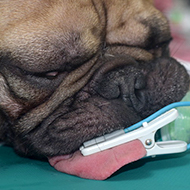
"Treated animals seem to improve faster and have lower clinical scores after surgery than untreated animals" - Dr Emilie Vangrinsven.
Giving antacids to brachycephalic dogs undergoing surgery could result in better treatment outcomes, according to new research.
The study, published in the Journal of Small Animal Practice (JSAP), assessed the effects of antacid treatments (omeprazole (omeprazole (1mg/kg PO q24 hours) and magaldrate (5-10mL/dog PO q8-12 hours) on dogs with brachycephalic syndrome.
JSAP editor Nicola Di Girolamo said: “Based on this study, antacid treatment administered to brachycephalic dogs undergoing surgery may be beneficial. It should be noted that a direct influence of antacid treatment on digestive clinical and lesion scores could not be significantly demonstrated, which may have been because of the lack of an actual difference, or as a result of the small sample size.”
In the study, 18 dogs were randomly prescribed antacids while 18 other dogs did not receive any gastrointestinal medical treatment. Digestive clinical signs and gastro-oesophageal junction abnormalities (GJA) were assessed and scored at presentation, at the time of surgery and at recheck.
Researchers also assessed GJA during endoscopy under standard conditions and during endotracheal tube obstruction. A single, blinded reviewer recorded and reviewed all endoscopic procedures.
The procedure was also performed in a control group of 10 dogs to see if endotracheal tube obstruction manoeuvre accurately detects GJA. Healthy control dogs were anaesthetised for independent purposes.
Corresponding author Dr Emilie Vangrinsven said: “Although results of multivariate analysis failed to demonstrate a direct effect of antacid treatment, a significant interaction between antacid treatment status and improvement of digestive clinical score throughout the endoscopies was present, meaning that treated animals seem to improve faster and have lower clinical scores after surgery than untreated animals. Furthermore, a significant improvement in GJA-obstruction score was present in the treatment group only.
“In contrast to standard endoscopy, the obstruction manoeuvre during endoscopy allowed detection of GJA in dogs, even in the absence of clinical signs. We were concerned that the obstruction manoeuvre may induce false-positive results for the diagnosis of dynamic GJA; in the control group, GJA during obstruction manoeuvre were found to be negligible suggesting that this technique does not significantly overestimate the presence of GJA.”
Image (C) Ian Ramsey.


 Eligible members of BEVA will be able to vote for their Council team until Monday, 17 August 2026. Members will have received an election email on 17 July.



