


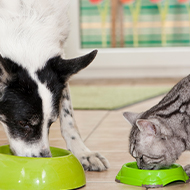
Scientists assess the effects of milk oligosaccaharides on gut health.
Researchers at the University of Illinois have found that milk oligosaccaharides could be beneficial to cats and dogs when added to their diets.
Milk oligosaccahraides are complex carbohydrate supplements that are naturally present in mammalian milk.
In recent years, human milk oligosaccahraides have attracted much attention owing to their role in boosting beneficial gut microbes in babies. Now, new research suggests they could benefit cats and dogs, too.
In the first of three studies, researchers identified the predominant oligosaccharide structures in canine and feline milk. Their findings are published in PloS ONE.
In canine milk, the team identified three structures that make up more than 90 per of total oligosaccharides. Feline milk was more complex and balanced, with around 15 compounds making up 90 per cent of total oligosaccharides.
"Our study was the first robust characterization of dog and cat milk oligosaccharides,” commented Professor Kelly Swanson, lead author of the study. “Our data not only provide a better understanding of how milk meets the nutritional needs of newborn kittens and puppies, but also how it helps promote gut immunity and establish a healthy gut microbial community early in life.”
Next, researchers tested the safety, palatability and digestibility of an animal milk oliosaccahraide-like product called GNU100. GNU100 was launched by Swiss biotech firm Gnubiotics Sciences in 2019 but had not been tested on animals.
After testing confirmed the product was not toxic, the team mixed GNU100 at one per cent with a fat source and coated commercial dry diets for cats or dogs. Fat-coated diets without GNU100 were also offered as a control.
They found that when the animals had the option to choose between the control and the one per cent bowls, they went crazy for the GNU100.
Prof. Swanson said: “In the cats, it was a huge preference. They ate nearly 18 times more food with GNU100 than the control food. We had just been hoping they wouldn’t reject it. You know, cats can be pretty finicky. When we got the data back it was like, wow, they really love that stuff! And the dogs did, too.”
Finally, Swanson and his team included GNU100 in experimental diets at 0 per cent, 0.5 per cent, 1 per cent, and 1.5 per cent and fed them to healthy adult dogs and cats for six months. Stool quality, blood metabolites, and nutrient digestibility were measured throughout the experiment, as were changes in gut metabolites and the gut microbial community.
The team noted that cats did well with GNU100, with no adverse health effects. Researchers also saw shifts in the gut microbiome toward more beneficial species and their metabolite profiles.
“Theoretically, these products should stabilize and feed good bacteria in the gut as well as limit the growth of potentially undesirable bacteria. So if an animal is undergoing treatment for something with antibiotics or is in a high stress situation, having that product in the diet might keep the gut from destabilizing,” said Prof. Swanson.
“Another target group for these products might be young animals as a way to maintain beneficial bacteria in the gut as they wean off their mothers. We’d need to do more testing to see if the product holds up in those target groups, but at least we know now that it is safe and well tolerated.”


 Eligible members of BEVA will be able to vote for their Council team until Monday, 17 August 2026. Members will have received an election email on 17 July.



