


Novel procedure avoids the need for general anaesthesia.
A kitten suffering from crippling eye pain and corneal damage has been treated using human lip filler.
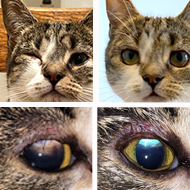
Domestic shorthair Nala was born with a condition called eyelid coloboma, a common abnormality of cats in which parts of the upper eyelid do not form. In Nala's case, there was a small section missing in her upper right eyelid.
Eyelid coloboma can result in corneal exposure and trichiasis (contact of facial hairs against the corneal surface). In turn, this can lead to chronic discomfort and severe damage to the cornea due to ulceration and scarring.
When Nala was presented to Davies Veterinary Specialists, she was in considerable discomfort with her right eye tightly closed. Ophthalmology clinician Rachel Lockhart explained that, given the amount of pain Nala was in, she would need some form of surgical correction.
Current surgical options for eyelid coloboma aim to reconstruct the upper eyelid by moving portions of the lower eyelid or even the upper lip into the defect. However, these surgeries can be extensive and often need multiple operations.
Before committing Nala and her owners to surgery, Rachel suggested an alternative option - sub-dermal sodium hyaluronate filler injections, most commonly known as human lip-filler.
The procedure involves injecting the filler under the skin surrounding the defect to realign the skin hairs and divert them away from the eye. While only a short-term fix, it can be performed under sedation, avoiding the need for general anaesthesia.
“The filler is broken down by the body and the effect is technically only temporary,” Rachel explained. “But it may persist for many months in some individuals so it can afford a good level of comfort for a considerable time.
“Eventually Nala may need definitive surgery but for the time being the filler is keeping her eye comfortable.”
Commenting on Nala's transformation, owner Lucy Peacock said: “Nala was clearly suffering and really struggled to keep her eye open - it was devastating to see her looking so dejected. We were really worried about the potential damage that was being caused to her sight in the long term, but after just a small and unobtrusive procedure, she is like a different kitten!
“Rachel was so helpful in talking us through our potential options and making recommendations for what was best for Nala. We felt really at ease with the whole process, and whilst we are fully aware that Nala may need surgery in the future, we are just happy to see her back to her mischievous, adorable self for the time being. I can’t thank Rachel enough.”
Image (C) Davies Veterinary Specialists.


 Eligible members of BEVA will be able to vote for their Council team until Monday, 17 August 2026. Members will have received an election email on 17 July.



