
Your data on MRCVSonline
The nature of the services provided by Vision Media means that we might obtain certain information about you.
Please read our Data Protection and Privacy Policy for details.

In addition, (with your consent) some parts of our website may store a 'cookie' in your browser for the purposes of
functionality or performance monitoring.
Click here to manage your settings.
If you would like to forward this story on to a friend, simply fill in the form below and click send.

Your friend's email:
Your email:
Your name:
 
 
Send Cancel

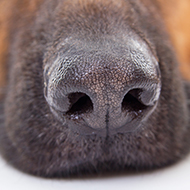
COVID-19 sniffer dogs detect virus with 94 per cent accuracy
"Dogs can really sniff out people with infections and without infections, as well as asymptomatic and symptomatic COVID patients." - Holger Volk.

Dogs to be used to prevent virus spread in public spaces.

A veterinary clinic in Germany has successfully trained detection dogs to detect COVID-19 in human saliva samples with 94 per cent accuracy.

A three-year-old Belgian shepherd named Filou and a one-year-old Cocker spaniel named Joe Cocker, are two of the dogs being trained at Hanover’s University of Veterinary Medicine.

They are conditioned to scent out the 'corona odour' that emanates from the cells of people infected with the virus.

Head of the veterinary clinic Holger Volk said: “We did a study where we had dogs sniffing samples from COVID-positive patients and we can say that they have a 94 per cent probability in our study ... that they can sniff them out.”

“So dogs can really sniff out people with infections and without infections, as well as asymptomatic and symptomatic COVID patients.”

Stephan Weil – the Prime Minister of the state of Lower Saxony, where Hanover is located – expressed his support for the study, calling for 'feasibility tests' at selected events before the dogs could be put to work in everyday life.

Across the world sniffer dogs are being used to detect COVID-19 in public spaces. Dubai airport, Finland’s Helsinki-Vantaa airport and Chile’s Santiago international airport are using COVID-19 detection dogs, and sniffer dogs were also used to check fans at a recent Miami Heat basketball game in Florida.


Become a member or log in to add this story to your CPD history

Equine Disease Surveillance report released for Q4 2025

News Story 1
 The latest Equine Disease Surveillance report has been released, with details on equine disease from Q4 of 2025.

The report, produced by Equine Infectious Disease Surveillance, includes advice on rule changes for equine influenza vaccination.

Statistics and maps detail recent outbreaks of equine herpes virus, equine influenza, equine strangles and equine grass sickness. A series of laboratory reports provides data on virology, bacteriology, parasitology and toxicosis.

This issue also features a case study of orthoflavivus-associated neurological disease in a horse in the UK. 

Click here for more...
News Shorts
RCVS annual renewal fee for vets due

RCVS' annual renewal fee for veterinary surgeons is now due. Vets must pay their renewal fee before Wednesday, 1 April 2026.

This year's standard annual fee has increased to 431 from last year's 418. This is an approximately three per cent increase, as approved by RCVS Council and the Privy Council.

Tshidi Gardner, RCVS treasurer, said: "The small fee increase will be used to help deliver both our everyday activities and our new ambitious Strategic Plan, which includes aims such as achieving new legislation, reviewing the Codes of Professional Conduct and supporting guidance, and continuing to support the professions through activities such as the Mind Matters Initiative, RCVS Academy and career development."

A full breakdown of the new fees is on the RCVS website. Information about tax relief is available on the UK government website.

