


Tributes paid to Wildlife Vets International founder
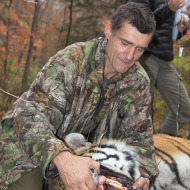
Dr Lewis with a large Amur tiger, Russian Far East.
Tributes have been paid to the founder of Wildlife Vets International (WVI), Dr John Lewis, who has died following a short illness.
A graduate of the University of Cambridge, Dr Lewis worked as a pathologist and clinician before joining the International Zoo Veterinary Group (IZVG) in 1985, where he later became a partner.
Renowned for his love of big cats, Dr Lewis founded WVI to support vets and conservationists using veterinary science to protect endangered species. Besides providing WVI with advice and guidance, he also participated in numerous conservation projects, specialising in Amur tigers and leopards in the Russian Far East.
Olivia Walter, executive director of WVI, said: “We are devastated to lose John, a mentor and an inspiration for so many zoo and wildlife vets and biologists for the last 35 years. Through his passion for the conservation of big cats, he truly became a world leader in his field. His skill and dedication with fieldwork, including his expertise in field anaesthesia, were second to none. He inspired many and his passing is an unimaginable loss to wildlife veterinary medicine.”
Besides his work with tigers, Dr Lewis was also considered an expert in primates, elephants, marine mammals and zoo and wild animal anaesthesia. He was a veterinary adviser to the Amur Leopard and Tiger EEPs (EAZA Ex-Situ Programme) and a member of the IUCN SSC (Species Survival Commission) Cat specialist group.
Dr Sue Thornton, a senior partner at IZVG, said: “The messages of support from vets, biologists and zookeepers we have received are consistent in their praise for John’s willingness to pass on his knowledge and expertise to all who worked with him or attended conferences or workshops with him. Within IZVG he was always willing to discuss a case with a colleague and was equally willing to admit when he did not know the answer. His anecdotes and admissions of failure were often delivered with great humility and humour.
“We and the animals he has cared for have all benefited from John’s knowledge and veterinary skills. His passing is a huge loss to the whole zoo and wildlife conservation industry. He has, however, left a legacy in the charity Wildlife Vets International, as well as his more recent project to develop a website (Wildtigerhealthcentre.org) to support rangers and conservation vets and biologists in the care of wild tigers.”
To leave a message of condolence, contact Olivia Walter at o.walter@wildlifevetsinternational.org or visit tolbc.com/DrJohnLewis


 Companies marketing medicines for small pets exempt from authorisation must submit their annual return to the Veterinary Medicines Directorate (VMD) by 30 November 2026.



