


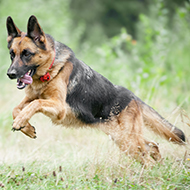
Researchers assess the impact of body shape variations on motion.
Movement of German shepherd dogs is dependent on their shape - particularity the curvature of their spine, according to new research.
The study by vets at the University of Surrey found that German shepherds with 'sloped backs' support more weight on their forelimbs and place the limbs closer together while standing.
It also revealed one-sided differences in the movement of joints in the back limbs of the dogs, suggesting that German shepherds with sloped backs experience greater motion lop-sidedness.
The unique study was funded by the Kennel Club through the Kennel Club Charitable Trust.
Dr Constanza Gómez Álvarez, a former lecturer in musculoskeletal biology at the university's School of Veterinary Medicine, said: “A common feature of some German shepherds is a distinct sloping and/or curvature of their spine. It was previously thought such differences were purely aesthetic and had no impact on the animal’s motion but what we have found dispels such notions.
“Those with a sloping back move differently, and not always in a symmetric way. These results highlight a link between sloping backs and the biomechanics of German shepherd dogs that may go some way in explaining the prevalence of clinical conditions in some dogs but not others, like hip and elbow dysplasia.”
In the study, 60 German shepherds and their owners were invited into the University of Surrey's Biomechanics Laboratory, where researchers used infrared motion capture cameras and light-reflecting sensors to examine the dogs’ movements. A high-resolution foot pressure platform was also used to observe foot loading.
The study revealed unilateral differences in the movement of joints in the back limbs of the dogs - in particular, stifle flexion, hock flexion and hock adduction and external rotation, suggesting greater motion lop-sidedness in dogs with a more sloped back.
Externally rotated hocks on any dog are known to be linked to lack of muscle balance in the hind limbs in dogs with a spread stance, the researchers said. This indicates that maintaining a healthy muscle mass in the hindlimbs can be essential in this breed.
Dr Gómez Álvarez added: “These results highlight a link between sloping backs and the biomechanics of German Shepherd Dogs that may go some way in explaining the prevalence of clinical conditions in some dogs but not others, like hip and elbow dysplasia.
“Further investigations resulting from the 200 dogs with signs of musculoskeletal pain will show if there is any correlation between joint pain and shape or not at all.”


 Eligible members of BEVA will be able to vote for their Council team until Monday, 17 August 2026. Members will have received an election email on 17 July.



