


Pheromones key to harmonious pet relationships – study
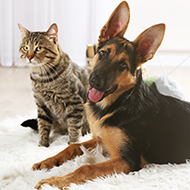
Pet owners in the study noted a fall in undesirable interactions, such as their dog chasing the cat.
A first-of-its-kind study led by the University of Lincoln has revealed that pheromones could be the key to a harmonious cat-dog relationship.
The study, published in the journal Frontiers in Veterinary Science, analysed the effects of two different pheromone products – Feliway Friends (Cats) and Adaptil (Dogs) - on cat-dog interactions. Researchers found that both products had a positive impact on the interactions between cats and dogs living in the same household.
Over six weeks, pet owners noted a decrease in undesirable interactions, such as their dog chasing a cat, or their cat hiding from the dog. Adaptil users also noted a rise in some desirable behaviours, such as friendly greetings between cat and dog, and time spent relaxing in the same room.
Professor Mills, a professor of veterinary behavioural medicine in Lincoln's School of Life Sciences, said: "Although we are all aware of the perceived tensions between cats and dogs, we believe this is the first study of its kind to explore the use of pheromone products to improve the relationship when the two species are living in the same household.
“Many cat and dog owners report that their animals are comfortable in each other's company, but where this isn't the case, a poor relationship between a resident cat and dog can have serious consequences for the welfare of individual animals.”
In the study, pet owners were split into two groups and randomly assigned an unlabelled pheromone. The group reported weekly on the frequency of 10 specific undesirable interactions and seven specific desirable interactions between their cats and dogs.
Researchers were aware that, in many households, the comfortability of the cat seemingly has a stronger influence over the quality of the cat-dog relationship. They were therefore surprised to learn that it was Adaptil - the product releasing dog pheromones - that increased specific desirable interactions.
Dr Miriam Prior, who undertook the work as part of her PhD, said: "While it might be expected that Feliway Friends would be more effective in multi-species homes given the apparently stronger contribution of the cat's comfortability to the quality of the cat-dog relationship, this did not appear to be the case. Our results might be explained by the behaviour of the dog being the primary determinant of the cat's quality of interaction with it.
"We would like to investigate this further to really tease out the effects of these pheromone products individually and also to investigate their use in combination with each other. We suggest that Adaptil may have had such a beneficial effect because a more relaxed dog may be less likely to disturb the cat (e.g. by chasing it), resulting in a cat that is less stressed and more willing to form some form of social bond with the dog."


 Eligible members of BEVA will be able to vote for their Council team until Monday, 17 August 2026. Members will have received an election email on 17 July.



