


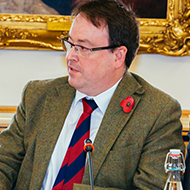
Professor David Argyle to assume role for 2020-21
Professor David Argyle has been appointed RCVS junior vice-president for 2020-21.
A Dean of the Royal (Dick) School of Veterinary Studies, Professor Argyle has been a member of RCVS Council representing the University of Edinburgh since 2011.
He stood as one of three candidates for junior vice-president, alongside Melissa Donald and Dr Danny Chambers, and was elected by RCVS Council at its meeting on Thursday 4 June 2020.
In his election statement, Professor Argyle said: “Alongside the major issues facing the professions relating to the COVID-19 pandemic, it is important to support the College in driving forward standards. This is a hugely challenging time for the professions, but also one of opportunity, and will require cohesive and inclusive leadership.
"The RCVS has set out an exciting forward-looking strategy with animal welfare and the public at its core, but also with a focus on the health of our professions (vets and nurses) and ensuring a strong future through innovative leadership and world-leading educational standards.”
Professor Argyle is a graduate of the School of Veterinary Medicine at the University of Glasgow. After a period in practice, he returned to Glasgow to complete a PhD in Oncology/Immunology. He was a senior lecturer in clinical oncology at Glasgow until 2002 when he became head of Veterinary Oncology at the University of Wisconsin-Madison, USA.
He returned to Edinburgh University in 2005 to the William Dick Chair of Veterinary Clinical Studies. In 2009 he became the Dean for postgraduate research and international research for both medicine and veterinary medicine. He later became the head of the Royal (Dick) School of Veterinary Studies.
Professor Argyle is an RCVS/European Specialist in Veterinary Oncology and Diplomat of the European College of Internal Medicine in Oncology. His major research interests are cancer and stem cell biology.
Speaking after his election, Professor Argyle said: “With our new strategy it is important we maintain momentum in delivering our priorities alongside supporting the profession in recovering from the COVID-19 pandemic. I am immensely proud to be able to serve the College in this role and be able to make a difference for our professions.”
Professor Argyle will take up the role of junior vice-president at the RCVS Annual General Meeting on Friday, 10 July 2020.
Image (C) RCVS.


 Companies marketing medicines for small pets exempt from authorisation must submit their annual return to the Veterinary Medicines Directorate (VMD) by 30 November 2026.



