


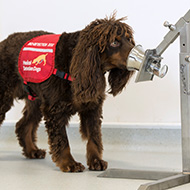
Dogs could provide a fast, non-invasive detection method for COVID-19.
A trial which will be able to see if specially-trained 'COVID dogs' can detect coronavirus in humans, even if they are not showing symptoms, is set to get underway in the UK.
It is hoped that the trial will establish whether the dogs could be used as a potentially new non-invasive, early warning measure to detect coronavirus in the future.
The first phase of the trial will be conducted by researchers at the London School of Hygiene & Tropical Medicine (LSHTM) in partnership with Medical Detection Dogs and Durham University. Backed by half a million pounds of government funding, it aims to see if dogs can detect coronavirus in humans from odour samples.
Medical Detection Dogs has successfully trained dogs to detect the odour of many different diseases in humans, such as cancer, malaria and Parkinson's disease. This new trial will see if the dogs can be trained to detect COVID-19 in people too, even if they are asymptomatic.
“Bio-detection dogs already detect specific cancers and we believe this innovation might provide speedy results as part of our wider testing strategy," explained innovation minister Lord Bethel. “Accuracy is essential so this trial will tell us whether ‘covid dogs’ can reliably detect the virus and stop it spreading.”
If the initial trial is successful, the dogs could be used to provide a fast, non-invasive detection method for COVID-19. It is one of several testing measures being explored to ensure a swift response to the outbreak.
In the first phase of the trial, NHS staff will collect odour samples from people who are infected with coronavirus and those who are not infected. Six medical detection dogs will then undergo thorough training to identify the virus from the samples.
Years of research shows that dogs can detect the odour of disease at the equivalent dilution of one teaspoon of sugar in two Olympic-sized swimming pools of water. Researchers estimate the covid detection dogs may be able to screen as many as 250 people per hour.
“Our previous work has shown that malaria has a distinctive odour, and with Medical Detection Dogs, we successfully trained dogs to accurately detect malaria,” commented Professor James Logan, lead researcher for the work and Head of the Department of Disease Control at the London School of Hygiene & Tropical Medicine.
“This, combined with the knowledge that respiratory disease can change body odour, makes us hopeful that the dogs can also detect COVID-19.”
Medical Detection Dogs CEO and co-founder Dr Claire Guest, added: “We are delighted that the government has given us the opportunity to demonstrate that dogs can play a role in the fight against COVID-19. They have the potential to help by quickly screening people, which could be vital in the future.
“We have already demonstrated our expertise in canine disease detection by successfully training dogs to detect diseases like cancer, Parkinson’s and malaria, and we apply that same science to train life-saving Medical Alert Assistance Dogs to detect odour changes in individuals caused by their health condition.”
She added: “We are sure our dogs will be able to find the odour of COVID-19 and we will then move into a second phase to test them in live situations, following which we hope to work with other agencies to train more dogs for deployment. We are incredibly proud that a dog’s nose could once again save many lives.”
Image (C) Medical Detection Dogs.


 Eligible members of BEVA will be able to vote for their Council team until Monday, 17 August 2026. Members will have received an election email on 17 July.



