


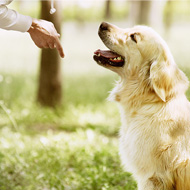
Researchers investigate the behaviour of dogs during puberty.
A new study has revealed for the first time that dogs go through a difficult 'teenage' phase, in a similar way to humans.
The research led by Newcastle University suggests that adolescent dogs are more likely to ignore commands from their owner, and are harder to train at the age of eight months when they are going through puberty.
Such behaviour was particularly noticeable in dogs that had insecure attachments to their caregivers, the researchers said. The findings are published in the journal Biology Letters.
“Many dog owners and professionals have long known or suspected that dog behaviour can become more difficult when they go through puberty,” explains co-author Dr Harvey from the University of Nottingham’s School of Veterinary Medicine.
“Until now there has been no empirical record of this. Our results show that the behaviour changes seen in dogs closely parallel that of parent-child relationships, as dog-owner conflict is specific to the dog’s primary caregiver and just as with human teenagers, this is a passing phase.”
In the study, researchers observed a group of 69 dogs to investigate behaviour in adolescence. The group consisted of Labradors, golden retrievers, and cross-breeds of the two at five months (before adolescence) and eight months (during adolescence).
They found that during adolescence, dogs took longer to respond to the 'sit' command. Interestingly this was only when the command was given by their owner and not a stranger.
Likewise, a questionnaire of 285 dog owners revealed that dogs were harder to train around adolescence, compared to when they were five months or 12 months old.
The experts also found that female dogs with insecure attachments to their caregivers were more likely to reach puberty early.
Lead author Dr Lucy Asher from Newcastle University warns adolescence can be a vulnerable time for dogs as many are taken to shelters for re-homing at this age.
“This is a very important time in a dog’s life. This is when dogs are often rehomed because they are no longer a cute little puppy and suddenly, their owners find they are more challenging and they can no longer control them or train them. But as with human teenage children, owners need to be aware that their dog is going through a phase and it will pass.”
Dr Asher adds: “It’s very important that owners don’t punish their dogs for disobedience or start to pull away from them emotionally at this time. This would be likely to make any problem behaviour worse, as it does in human teens”.


 Eligible members of BEVA will be able to vote for their Council team until Monday, 17 August 2026. Members will have received an election email on 17 July.



