


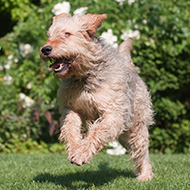
Scheme tests for Glanzmann’s thrombasthenia in the otterhound.
A new DNA testing scheme for one of the UK's rarest dog breeds has been approved by the Kennel Club.
The official scheme tests for Glanzmann’s thrombasthenia (GT) in the otterhound - a breed which saw a mere 44 puppy registrations in 2019, and is listed by the Kennel Club as a 'Vulnerable British Breed'.
It is hoped the test will combat inherited disease in otterhounds by enabling breeders to make more informed choices when deciding to breed a litter.
Breed health coordinator, Judith Ashworth, said: “The otterhound is basically a very healthy breed. However, as their numbers are very low, breeders need every assistance they can get when it comes to ensuring the breed is preserved for future generations, partly through breeding interaction across the world.”
GT is an inherited blood-clotting disorder characterised in dogs by bruising, frequent bleeding from the nose and blood in the urine and/or stools. Dogs with the condition normally show signs before the age of one, often by bleeding from the gums as their adult teeth emerge.
To acquire the condition, a dog must inherit two copies of an abnormal gene, one from its mother and one from its father, before its health is affected. A dog that inherits one copy of an abnormal gene will have no signs of the disease, but will be a carrier and may pass the gene on to any offspring.
Dogs that undergo the Kennel Club's GT test will be classed as either:
Clear
The dog does not have any copies of the abnormal gene associated with GT. The dog is highly unlikely to be clinically affected and will pass on only a normal copy of the gene to a puppy.
Carrier
The dog has one copy of the normal gene and one copy of the abnormal gene associated with GT. The dog is unlikely to be clinically affected but may pass on one copy of the normal gene, or one copy of the abnormal gene, to a puppy.
Affected
The dog has two copies of the abnormal gene associated with GT. The dog will be clinically affected by the disorder and will pass on one copy of the abnormal gene to any potential offspring.
Test results will be added to the dog’s registration details which will trigger the publication of the result in the next available Breed Records Supplement. The result will appear on any new registration certificate issued for the dog and on the registration certificates of any future progeny of the dog, and also on the Health Test Results Finder on the Kennel Club website.
To find out which laboratories the Kennel Club can record results from, and which labs will send results direct to the Kennel Club, please refer to the worldwide DNA testing list at thekennelclub.org.uk
Image (C) Kennel Club.


 Eligible members of BEVA will be able to vote for their Council team until Monday, 17 August 2026. Members will have received an election email on 17 July.



