


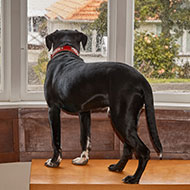
Researchers suggest new approach to treatment
Animal behaviour specialists at the University of Lincoln have found that understanding and treating the underlying frustrations that cause separation anxiety in dogs could be far more effective than treating the anxiety itself as a diagnosis.
The new study highlighted how different emotional states combine to produce problem behaviours in dogs. Although this is first triggered by separation from the owner, the study suggested that the unwanted behaviour arises because of several risk factors including the dog’s temperament and the relationship it has with its owner.
Researchers identified four key forms of distress for dogs separated from their owners, these include:
- focus on getting out of the house
- wanting to get to something outside
- reacting to external sounds or events
- a form of boredom.
They suggested that animal behaviourists should consider these underlying reasons as the issue that needs treating, rather than viewing ‘separation anxiety’ as a diagnosis.
Daniel Mills, professor of Veterinary Behavioural Medicine in the School of Life Sciences at the University of Lincoln, said: “Until now, there has been a tendency to think of this as a single condition, i.e. ‘My dog has got separation anxiety’ and then to focus on the dependence on the owner and how to make them more independent. However, this new work indicates that having separation anxiety is more like saying ‘My dog’s got an upset tummy’ which could have many causes and take many forms, and so both assessment and treatment need to be much more focused.
“Labelling the problem of the dog who is being destructive, urinating or defecating indoors or vocalising when left alone as separation anxiety is not very helpful. It is the start of the diagnostic process, not the end. Our new research suggests that frustration in its various forms is very much at the heart of the problem and we need to understand this variety if we hope to offer better treatments for dogs.”


 Eligible members of BEVA will be able to vote for their Council team until Monday, 17 August 2026. Members will have received an election email on 17 July.



