


Dogs have hidden coat colours
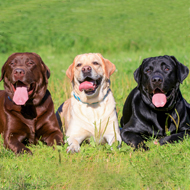
The chocolate Labrador (left) is an example of the expression of a 'fault' allele that is 'permitted' by the breed association
A study from Purdue University’s College of Veterinary Medicine, published in PLOS ONE, shows that some breeds of dog have hidden coat colors – and in some cases, other genetic traits – that are not commonly expressed.
Led by Kari Ekenstedt, assistant professor of anatomy and genetics, and lead scientist, Dayna Dreger, the team looked at a dozen different genes in 212 dog breeds. Purdue researchers, together with industry partners at Wisdom Health, analysed data that had been initially collected for the development of canine DNA tests.
“These are purebred dogs with traits that their breed clubs say they’re not supposed to have,” said Professor Ekenstedt, whose research programme focuses on canine genetics. “The message of this paper is, ‘Hey, these gene variants exist in your breed, and if a few dogs are born with these traits, it’s not caused by accidental breeding and it’s not a mutt; it’s a purebred showing this known genetic potential!’”
Along with analysing the data, researchers used standard breed descriptions from major American and international dog breed registries to determine coat colours and tail lengths that were accepted within each breed. According to the scientists, there was a great deal of unexpected information. “When it comes to different dog breeds, their standards are mostly based on preference and aesthetics,” said Dr Dreger. “We make assumptions for certain breeds based on what we expect their coat colours to be.”
Coat colour genes have a significant amount of epistasis between them, meaning that what happens at one gene can mask what’s happening at another gene. Because of epistasis, it’s rare to see those masked genes actually expressed in a dog’s coat colour.
One example of a ‘fault’ allele – a gene variant that would cause a trait that is not allowed in a breed standard – is an allele that causes the brown colour, which affects both hair pigment and skin pigment. The colour is allowed in breeds such as the Labrador retriever, where it causes the chocolate colour. However, researchers observed that in breeds where brown is not allowed, such as the Rottweiler and the German shepherd dog, brown alleles exist at low frequencies.
Another example of a fault allele is in the Weimaraner, which exists in both long-haired and short-haired varieties. At least one dog breed organisation does not allow long-haired Weimaraners, while several others do. Of the Weimaraners sampled in this data, the long-haired allele is present at a four per cent frequency.
The same goes for other traits too. For example, there are around 18 recognised breeds of dogs that have the genetic potential to be born without a tail – such as the popular Australian shepherd dog. But the data show that up to 48 of the breeds analysed possess the tailless gene variant, usually at a very low frequency. One of those breeds is the Dachshund! “A breeder would certainly be surprised to see a Dachshund born without a tail,” Dreger said. “The chances are low, but our research shows that the potential is there.”
Both Dreger and Ekenstedt hope the research prompts some discussions within the dog community. “I want this to start science-based conversations,” Dreger said. “We’re not here to make decisions on what a breed should or shouldn’t look like or what a breed club should do. We’re here to say these are the facts, and these are the gene variants that naturally exist in these breeds.”
“There’s an assumption that the standards for these different breeds of dogs are set in stone,” Dreger said. “People will often make assumptions that if it doesn’t match this, it’s not purebred. These data show that there is a wealth of variation and the standards are not as concrete as we expect them to be.”


 Eligible members of BEVA will be able to vote for their Council team until Monday, 17 August 2026. Members will have received an election email on 17 July.



