


Red deer responding to climate change
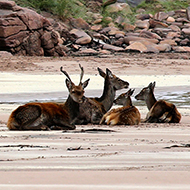
Red deer on the Isle of Rum
Field records and genetic data, collected on the Isle of Rum over a 45-year period since 1972, demonstrate that genetic changes to red deer have played a key role in a rapid shift in birth dates in recent years.
Previous studies have shown that the deer have been giving birth earlier since the 1980s at a rate of about three days per decade – partly as a consequence of the effects of warmer temperatures on the deer’s behaviour and physiology.
Researchers, including scientists from the University of Edinburgh, have now revealed that genetic changes caused by natural selection are also involved – their study providing a rare example of evolution happening quickly enough to be detected over only a few decades.
Female red deer give birth to a single calf each year, and those that reproduce earlier in the year have more offspring over their lifetime, researchers say. Their findings show that this is partly because of an association between the genes that make hinds give birth earlier and higher overall reproductive success. As a result, genes for breeding earlier have become more common in the Rum deer population over time.
Dr Timothée Bonnet, of the Australian National University, who led the study, said: “This is one of the few cases where we have documented evolution in action, showing that it may help populations adapt to climate warming.”
Professor Josephine Pemberton, of the University of Edinburgh’s School of Biological Sciences, who was also involved in the study, said: “Long-term studies of individual lifetimes are one of the few ways to understand how populations respond to environmental change and how to manage its effects.”
Sally Thomas, Scottish Natural Heritage’s Director of People and Nature, said: “These findings are a fascinating example of the impact climate change may be having on wildlife. More and more research is demonstrating climate change is influencing species across the UK and the world.”
The research, published in PLOS Biology, involved scientists from the Australian National University and the universities of St Andrews and Cambridge. It was funded by the Natural Environment Research Council. The Isle of Rum National Nature Reserve is managed by Scottish Natural Heritage.


 Companies marketing medicines for small pets exempt from authorisation must submit their annual return to the Veterinary Medicines Directorate (VMD) by 30 November 2026.



