


Non-invasive sampling enhances reptile conservation
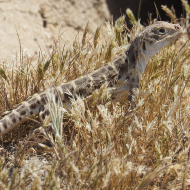
A blunt-nosed leopard lizard (Photo: Mark Statham/UC Davis)
A black-and-white dog sits in the desert, concentrating on the tracks of lizards. Seamus, a trained detection dog, alerts his handler to the presence of excrement.
Trained conservation dogs have been used to locate faeces and collect DNA samples for everything from bears and foxes to gorillas and whales. But the technique had not been used for reptiles until recently when scientists developed a novel approach to identify the presence of the blunt-nosed leopard lizard in the Panoche Hills Recreation Area and Carrizo Plain National Monument in the USA.
They have developed new methods to recover DNA from faeces and genetically identify lizard species in the same area; and their study, published in the Journal of Wildlife Management, is a proof of concept for a host of reptiles.
The researchers claim that detection dogs trained to sniff out the faeces of endangered lizards – combined with genetic species identification – could represent a new, non-invasive sampling technique for lizard conservation worldwide.
Current methods for surveying lizard species typically rely on live capture or visual surveys. Excrement sampling allows biologists to study elusive, rare or dangerous animals without the need for direct contact. In addition to informing about the presence, habitat and genetics of an animal, faeces can also be analysed to inform researchers about diet, hormones, parasites and other health factors.
Using the new method, the authors genetically identified specific species for 78 per cent of the 327 samples collected by dog-handler teams across four years. Most (82%) of those identified were confirmed as being from blunt-nosed leopard lizards.
To meet regulatory monitoring requirements, more research is needed to assess the viability of using detection dogs to recover usable DNA on a larger scale. But the research highlights the broad potential this method holds for surveying and monitoring reptiles.
The study from the University of California, Davis, was published in partnership with the non-profit Working Dogs for Conservation, US Geological Survey and the US Bureau of Land Management, which organisation also funded the work.


 A nationwide roadshow offering free, personalised parasite risk assessments and flea and tick checks will be visiting popular dog events across the UK.



