


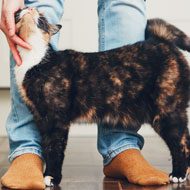
New research shows cats display distinct attachment styles
Researchers have shown for the first time that domestic cats form bonds with their owners in a similar way to children and dogs.
Writing in the journal Current Biology, scientists at the University of Oregon show how cats display distinct attachment styles towards their owners.
Lead author Kristyn Vitale said: “In both dogs and cats, attachment to humans may represent an adaptation of the offspring-caretaker bond. Our study indicates that when cats live in a state of dependency with a human, that attachment behavior is flexible and the majority of cats use humans as a source of comfort.”
In the study, researchers conducted a “secure base test” in which a cat spends two minutes in a new room with their caregiver, followed by two-minutes alone, and then a two-minute reunion phase.
The test is similar to one given to babies and dogs to study their attachment behaviours.
Researchers found that when the caregiver returned, cats with secure attachment to the person were less stressed and balanced their attention between the person and their surroundings. For example, exploring the room around them.
Conversely, cats with an insecure attachment displayed stress signals such as twitching their tail and licking their lips. They also either avoided the person or clung to them by jumping in their lap and not moving.
Of the 70 felines that were monitored in the study, 64.3 per cent were categorised as securely attached and 35.7 per cent were categorised as insecurely attached. The researchers say that such a split has also been observed in research involving dogs and infants.
Subsequent experiments looked at the effect of socialisation training on these percentages. However, after a six-week training course there weren’t any significant differences.


 Eligible members of BEVA will be able to vote for their Council team until Monday, 17 August 2026. Members will have received an election email on 17 July.



