


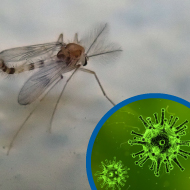
Biting midge population carries previously-unknown viruses
According to new research, published in Viruses, scientists at the MRC-University of Glasgow Centre for Virus Research have used high-throughput sequencing to study, for the first time, to determine the total collection of viruses in the biting midge, Culicoides impunctatus.
The scientists discovered several new viruses in the ‘virome’ of the midge, including an alphanodavirus, two rhabdo-like viruses and a chuvirus. These viruses are mainly found in insects and other invertebrates, but some members of the alphanodaviruses naturally infect pigs and herons, sometimes causing death.
The newly-identified viruses were found to be sufficiently different from known species to be categorised as novel. However, there is currently no evidence that these viruses pose a threat to humans.
Despite their prevalence in Scotland, midges – small biting flies that are a predominantly a nuisance to humans – are currently understudied. Yet midges are carriers of arboviruses (viral infections transmitted to humans from a group of insects) and were responsible for the emergence and spread of Schmallenberg virus in Europe in 2011, and are likely to be involved in the emergence of other arboviruses in Europe.
There are at least 41 different species of biting midge described in the UK, of which 37 are present in Scotland.
Viral metagenomics, the name of the technique used to identify the midge viruses, has been widely presented and accepted within the scientific community as one of the most unbiased methods for the characterisation of viral sequences.
The midges studied were collected at the University of Glasgow’s Scottish Centre for Ecology and the Natural Environment, located within the Loch Lomond and Trossachs National Park; and the study was funded by the Medical Research Council.


 Companies marketing medicines for small pets exempt from authorisation must submit their annual return to the Veterinary Medicines Directorate (VMD) by 30 November 2026.



