


Philippines confirms first outbreaks of ASF
Strict quarantine and monitoring protocols are in place to protect pig farms elsewhere in the country.
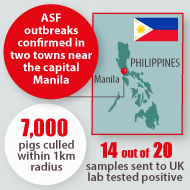
The Philippines has culled more than 7,000 pigs following the country’s first outbreaks of African swine fever (ASF).
Agriculture secretary William Dar told a press briefing that 14 out of 20 samples tested positive for ASF at a UK laboratory.
Tests are ongoing to confirm if the strain is similar to that seen in Vietnam and China.
According to local news reports, the outbreaks occurred in two towns close to the capital Manila. Authorities suspect the source of the infection could be backyard pig keepers feeding ‘swill’ - leftover food scraps from hotels and restaurants.
Other possible routes include frozen meat being smuggled into the country and overseas workers returning with infected pork products.
Strict quarantine and monitoring protocols are in place to protect pig farms elsewhere in the country. The Department for Agriculture also suspended ground operations in Rizal province to focus on cleaning and disinfecting.
The Philippine government is reassuring the public that it is safe to eat pork. Around 65 per cent of the country’s PHP260 billion (approx £4 billion) swine industry is contributed by small backyard pig keepers.
Myanmar and Serbia last month confirmed their first cases of ASF, while 130,000 pigs were culled in Bulgaria due to the virus between 19 July and 3 August.
The disease has spread widely across Asia, as well as to parts of central and Eastern Europe and sub-Saharan Africa. It has led to the deaths of more than 800,000 pigs and wild boar in Europe and around four million pigs in Asia.
Defra implemented a new campaign at UK borders in July, in a bid to keep ASF out of Britain. It is predicted that if the disease enters the UK, it could have a devastating impact on the country’s commercial pig industry, which numbers five million pigs.


 Companies marketing medicines for small pets exempt from authorisation must submit their annual return to the Veterinary Medicines Directorate (VMD) by 30 November 2026.



