
Your data on MRCVSonline
The nature of the services provided by Vision Media means that we might obtain certain information about you.
Please read our Data Protection and Privacy Policy for details.

In addition, (with your consent) some parts of our website may store a 'cookie' in your browser for the purposes of
functionality or performance monitoring.
Click here to manage your settings.
If you would like to forward this story on to a friend, simply fill in the form below and click send.

Your friend's email:
Your email:
Your name:
 
 
Send Cancel

Rise in heartworm cases prompts warning
‘Veterinary professionals need to be vigilant for exotic parasites entering the UK in imported dogs.'

Number of infected imported dogs ‘likely to increase’

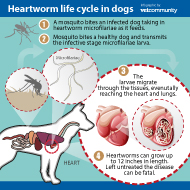
A reported rise in enquiries about heartworm in dogs has prompted a warning about rescue dogs being imported to the UK.

ESCCAP UK & Ireland says there have been five heartworm cases in the past four weeks, not just in dogs from endemic countries in Europe, but also the US, Mauritius and Brazil.

Head of ESCCAP Ian Wright said veterinary professionals should be vigilant for exotic parasites in imported animals.

He explained: ’The increased numbers of dogs imported from Southern and Eastern Europe combined with the parasite spreading through Eastern Europe means that numbers of positive imported dogs are only likely to increase over the coming months and years.

‘Veterinary professionals need to be vigilant for exotic parasites entering the UK in imported dogs. This spike in heartworm cases is another example of the wide range of pathogens that might be encountered and the increasing risk to individual pets and owners as well as wider UK biosecurity as a result.’ 

Concerns over imported disease have been growing since the Pet Travel Scheme rules were relaxed in 2012.

Cases of imported disease over the past two years include babesiosis, canine ocular thelaziosis, tongue worm and Brucella canis. In March this year, there was also a confirmed case of leishmaniasis in an untravelled dog, which is thought to have contracted the disease from an imported dog.


Become a member or log in to add this story to your CPD history

SPVS and FIVP launch VSA survey

News Story 1
 SPVS and FIVP have collaborated to launch a short survey about the proposed reform of the Veterinary Surgeons Act.

The survey will ensure that each organisation's submission accurately represents the experiences of practising veterinary professionals. It will also explore awareness, use and perceived value of the roles undertaken by the RCVS.

It takes around 5-10 minutes to complete, and all responses are anonymous. The survey can be completed here until Thursday, 19 March 2026. 

Click here for more...
News Shorts
RCVS annual renewal fee for vets due

RCVS' annual renewal fee for veterinary surgeons is now due. Vets must pay their renewal fee before Wednesday, 1 April 2026.

This year's standard annual fee has increased to 431 from last year's 418. This is an approximately three per cent increase, as approved by RCVS Council and the Privy Council.

Tshidi Gardner, RCVS treasurer, said: "The small fee increase will be used to help deliver both our everyday activities and our new ambitious Strategic Plan, which includes aims such as achieving new legislation, reviewing the Codes of Professional Conduct and supporting guidance, and continuing to support the professions through activities such as the Mind Matters Initiative, RCVS Academy and career development."

A full breakdown of the new fees is on the RCVS website. Information about tax relief is available on the UK government website.

