


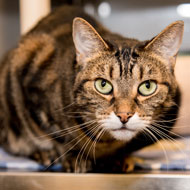
Study described as a 'major leap' towards a better understanding of pets
Scientists have identified 25 behavioural signs displayed by cats which could indicate they are suffering pain.
Led by the University of Lincoln, the expert consensus represents the first list of its kind to be agreed by a panel of veterinary experts in feline medicine.
Researchers hope the list will help cat owners and veterinary professionals identify important signs that the animals are in pain and lead to faster diagnosis of problems and illnesses.
“Both owners and veterinarians are clearly able to recognise many behavioural changes in cats which relate to pain. However, owners may not always recognise the clinical relevance of what they see,” commented Daniel Mills, professor of veterinary behavioural medicine at the University of Lincoln.
“For example, they may view the changes as an inevitable part of natural ageing and not report them to the vet as a concern, or at least not until the behaviours become quite severe. We hope that having an agreed list of more objective criteria, which relates to specific signs of pain, could improve the ability of both owners and vets to recognise it.”
Writing in PLOS ONE, researchers explain their study in which they gathered expert opinion on the possible behavioural signs in cats that denote pain. They then classified these signs as either ‘sufficient’ (their presence suggesting the cat is in pain) or ‘necessary’ (the signs must be present to conclude the cat is in pain).
Through repeating a process of behaviour analysis and selection, their study revealed 25 key ‘sufficient’ signs, such as a hunched-up posture, avoiding bright areas, an absense of grooming, difficulty jumping and a change in feeding behaviour.
Professor Mills continued: “Throughout the study, we consulted a variety of international experts so that we could be sure the signs were universal indicators of pain. By creating this core set of signs, we lay the foundation for future studies into the early detection of pain in cats, using scales which are crucially based on natural, non-invasive, observations.”
Supported by cat charity Feline Friends, the study involved prominent academic and clinical practitioners from across the world with specialisms including anaesthesiology, internal medicine, dentistry, oncology, dermatology, behaviour, neurology and ophthalmology.
Feline Friends chairman Caroline Fawcett desired the results as a 'major leap' towards a better understanding of pets:
“Cats are notorious for not showing that they are in pain, and the more that we can find out what the signals are, then the sooner we can get them to the vets for diagnosis and treatment.
"There is a long way still to go before the more subtle signs can be identified, but we are really excited about progress to date. The team at Lincoln is highlighting its dedication to cat welfare by tackling this extremely difficult project.”


 Eligible members of BEVA will be able to vote for their Council team until Monday, 17 August 2026. Members will have received an election email on 17 July.



