


Study reveals insights into equine hoof growth
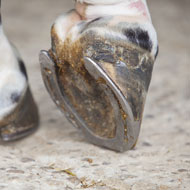
Researchers used physics, maths and cell biology to explain how the dorsal hoof wall can grow in a curved manner.
A study combining physics and biology has revealed new insights into equine hoof growth and how abnormal hoof shape may develop.
Published in the Journal of the Royal Society Interface, the study reveals how it is possible for the hoof growth rate to be greater than the potential growth rate of epithelial cells. It also explains how the synthesis of the hoof capsule starts from the coronary band, and that the soft papillae undergo gradual transition through three interpapillary regions into hard keratinised tissue.
Researchers used physics, maths and cell biology to explain how the dorsal hoof wall can grow in a curved manner as a result of faster growth from the coronary band at the quarters compared to the toe region.
The study was conducted by the University of Nottingham’s School of Veterinary Medicine in collaboration with the WALTHAM Centre for Pet Nutrition and the Royal Veterinary College (RVC).
Study lead Dr Cyril Rauch said: “With new scientific inputs from physics, mathematics and biology, this study provides an entirely new paradigm regarding hard growing tissues such as the horse hoof, which can be applied across cattle, sheep and other species, to unify a set of apparently disparate conditions and clarify the roles of physics and/or biology.”
Nicola Menzies-Gow of the RVC added: “We believe that this novel approach has the potential to provide alternative directions to follow with respect to understanding chronic hoof pathologies.”
Using live underweight and obese subjects, researchers assessed the influence of body weight on the balances of stresses affecting hoof growth. Their findings suggest that being proportionally heavier may promote straighter hoof growth, while being too lean may precipitate poor hoof growth and the development of a hoof with a dorsal curved shape.
The study also suggests that a high concentration of insulin stimulated equine progenitor keratinocytes - the outer layer of cells on the hoof wall - to grow in culture. Researchers said that if this also happens chronically within the live animal, it is possible that it could affect the growth stresses within the hoof and therefore promote a dorsal curved hoof shape.
“These results taken together can explain how the hoof grows and how it is possible for it to develop a dorsal curvature,” said Nicola. “However, it should be acknowledged that this does not take into account the genetic or metabolic influences on hoof growth nor the role of hoof trimming and shoeing in maintaining a mechanically healthy hoof. It is appreciated that the underlying biology of hoof growth remains an essential factor for hoof pathologies.”
Dr Rauch continued: “Given that the hoof is a weight bearing element it is essential to untangle the biology from the physics in this system; only then can meaningful biological and/or physical causes be prescribed for particular hoof shape. Removing the cause(s) when physically or biologically possible is essential to resolve hoof conditions.”


 A nationwide roadshow offering free, personalised parasite risk assessments and flea and tick checks will be visiting popular dog events across the UK.



