


mcr-3.1 found in US human patient
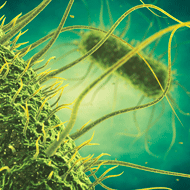
Salmonella enterica is responsible for a significant percentage of human illnesses in the US.
Scientists have found a gene that allows Salmonella to become resistant to last resort antibiotics in a human patient in the US.
The discovery provides the first evidence that the gene, mcr-3.1, has made its way to the US from Asia.
Salmonella enterica is responsible for a significant percentage of human illnesses in the US. mcr-3.1 confers resistance to colistin, the drug of last resort for treating multi-drug-resistant infections.
“Public health officials have known about this gene for some time,” said Siddhartha Thakur, director of global health at North Carolina State University. “In 2015, they saw that mcr-3.1 had moved from a chromosome to a plasmid in China, which paves the way for the gene to be transmitted between organisms.
“For example, E. coli and Salmonella are in the same family, so once the gene is on a plasmid, that plasmid could move between the bacteria and they could transmit this gene to each other. Once mcr-3.1 jumped to the plasmid, it spread to 30 different countries, although not – as far as we knew – to the U.S.”
Professor Thakur’s lab is one of several US labs that is participating in surveillance for resistant strains of Salmonella. Veterinary medicine student Valerie Nelson and PhD student Daniel Monte did genome sequencing on 100 clinical human stool samples from the southeastern US between 2014 and 2016.
One sample was found to contain the resistant mcr-3.1 gene. The patient had travelled to China two weeks prior to becoming ill with a Salmonella infection.
Prof Thakur added: “The positive sample was from 2014, so this discovery definitely has implications for the spread of colistin-resistant Salmonella in the US. Our lab will continue to try and fill in these knowledge gaps.”
The research has been published in the Journal of Medical Microbiology.


 Companies marketing medicines for small pets exempt from authorisation must submit their annual return to the Veterinary Medicines Directorate (VMD) by 30 November 2026.



