


Dogs accurately sniff out cancer in human blood
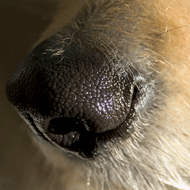
Dogs in the study could detect cancer in blood with almost 97 per cent accuracy.
Dogs can use their powerful sense of smell to accurately identify cancer in human blood, according to new research.
A study led by research and development firm BioScent DX found that dogs could detect the disease in blood with almost 97 per cent accuracy. The findings, presented at the 2019 Experimental Biology meeting (April 6-9) in Orlando, may lead to new non-invasive ways to detect cancer.
"Although there is currently no cure for cancer, early detection offers the best hope of survival," said lead researcher Heather Junqueira. "A highly sensitive test for detecting cancer could potentially save thousands of lives and change the way the disease is treated."
In the study, researchers used clicker training to train four beagles to
differentiate between normal blood and samples from patients with malignant lung cancer. Three out of the four dogs correctly identified lung cancer samples 96.7 per cent of the time and normal samples 97.5 per cent of the time.
"This work is very exciting because it paves the way for further research along two paths, both of which could lead to new cancer-detection tools," said Junqueira.
"One is using canine scent detection as a screening method for cancers, and the other would be to determine the biologic compounds the dogs detect and then design cancer-screening tests based on those compounds."


 Eligible members of BEVA will be able to vote for their Council team until Monday, 17 August 2026. Members will have received an election email on 17 July.



