


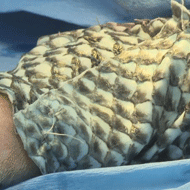
Spaniel’s wound was infected with resistant haemolytic E. coli
Vets have successfully carried out a pioneering fish skin graft on a dog with a seriously infected wound.
The five-year-old spaniel, Gigha, fell into a drainage ditch last summer which caused a tiny cut on her elbow. Whilst the wound did not initially appear serious, it later proved to be infected with a resistant haemolytic E. coli, resulting in significant loss of skin from the medial aspect of the elbow.
During this time Gigha was at serious risk of disseminated intravascular coagulation (DIC) and septicaemia.
Once the compromised tissue was debrided away she was left with a large wound, which was managed by vets at Skeldale Veterinary Centre for four days. Owing to the infection and lack of sufficient loose skin, a skin graft was not suitable for her case and vets explored novel methods to accelerate the healing process and relieve her pain.
Dr Guy Killick said: “Surgery using Tilapia fish skin grafts was pioneered at UC Davis in the USA and was used successfully on a horse with acid burns in the UK last year. It is still very rare, however, and had not been used to treat an infected wound before. Nor had it been used on a dog.
“Having done our research though and finding that these grafts have a natural anti-infective and analgesic effect, while also reducing the frequency of bandage changes that would cause discomfort and distress to the patient, we felt it was an appropriate treatment for Gigha and carried out the surgery a week after the initial wound.”
The surgery was straightforward, according to Dr Killick, and involved simply tacking the skin in place. It adhered to the developing granulation bed, accelerating its growth and providing an antiseptic and analgesic effect. The graft stayed in place for two weeks before breaking down and being removed and a new graft was placed for a further two weeks, until the wound was half its original size.
The team did not have access to further supplies, so the wound was then bandaged with traditional bandages. Within nine weeks, it was completely healed and eight months on, Gigha has made a full recovery.
Dr Killick said: “Given the large wound area and risk of further infection we decided on this novel approach to improve the quality of life for the patient while the wound was healing. While we were naturally apprehensive of making the first attempt at this potentially revolutionary technique, what we knew about fish skin grafts and suggested that they could work in her case so we were determined to give it a try.
“Looking at her now, you wouldn’t believe that she’d been days from death just a few months ago. Her case is a demonstration of the efficacy of fish skin grafts as a treatment for large wounds where there are no other suitable methods of closure – and for their use in dogs.”
Image © Skeldale Veterinary Centre


 Eligible members of BEVA will be able to vote for their Council team until Monday, 17 August 2026. Members will have received an election email on 17 July.



