


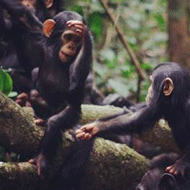
Two human linguistic laws observed in wild chimpanzees
Chimpanzee gestures follow the same linguistic laws that are seen in human language, research has shown for the first time.
Researchers from the University of Roehampton studied videos of gestures made by wild chimpanzees living in the Budongo Forest Reserve in Uganda. They looked at more than 2,000 gestures, of 58 different types, that were made during play.
The most frequently used gestures were found to be shorter in duration. In longer sequences, the average gesture duration was also shorter.
This follows two linguistic laws seen in human language - Zipf’s laws of abbreviation, which predicts that more commonly used words tend to be shorter; and Menzerath’s law, which predicts that longer words are made up of shorter syllables.
These laws are known to exist in many human languages but had not previously been explored in gestural communications between animals.
The findings, published in the journal Proceedings of the Royal Society B, suggest chimpanzee gestures may be more similar to our own language than previously thought.
Lead author, Raphaela Heesen, said: “Primate gestural communication is, of course, very different to human language, but our results show that these two systems are underpinned by the same mathematical principles. We hope that our work will pave the way for similar studies, to see quite how widespread these laws might be across the animal kingdom.”
Image © Dr Catherine Hobaiter


 Companies marketing medicines for small pets exempt from authorisation must submit their annual return to the Veterinary Medicines Directorate (VMD) by 30 November 2026.



