


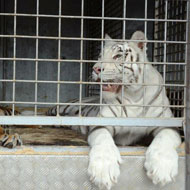
Research unveils flourishing illegal trade
Over 1,400 live captive-bred tigers from the EU were legally exported between 1999 and 2016, according to new research by the charity FOUR PAWS.
It is thought that several of these animals ended up in Asian tourist areas or were killed for traditional Chinese medicine.
In the same period, 8,278 illegal tiger products, such as tiger bouillon cubes, teeth and claws, as well as 57 illegal live tigers, were confiscated in the EU.
Europe’s tiger business is said to be worth more than €50 million (£45 million) and FOUR PAWS says the trade in tiger parts is wide reaching. There is evidence of illegal activity across France, Italy, Belgium, Slovenia, Spain, Denmark, the Netherlands, the UK, Germany and the Czech Republic.
On the black market, a live tiger can fetch up to €22,000 (£20,000), while a kilo of tiger bones is available for €1,700 (£1,500), and a litre of ‘tiger wine’ - a broth made from tiger bones - can be bought for €85 (£75).
Trade in wild tigers is banned in the EU, but the trade in captive-bred tigers is legal. FOUR PAWS says regulation and enforcement of the law is lacking and, as a result, it is not known how many captive and traded tigers there are in Europe.
Kieran Harkin, head of wildlife campaigns at FOUR PAWS, commented: "The world has already lost more than 90 percent of its tigers. There are only about 3,900 tigers and in the wild, yet the number of tigers held in captivity is unknown. The new findings and the extent of the tiger trade in Europe are therefore more than shocking.
“We call on the European Commission to protect the endangered tigers and ban commercial trade in captive-bred tigers. Tiger traders and their cruel business should no longer have a place in the EU.”
FOUR PAWS has launched a petition calling for the EU to ban the commercial trade in captive-bred tigers.
Image © VIER PFOTEN


 Companies marketing medicines for small pets exempt from authorisation must submit their annual return to the Veterinary Medicines Directorate (VMD) by 30 November 2026.



