


Conservationists call for action to protect endangered marine animal
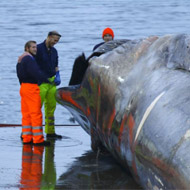
An endangered blue whale has been illegally killed and butchered by an Icelandic whaling company for export to Japan.
According to Sea Shepherd Global, the whale is the 22nd endangered whale slaughtered by Kristján Loftsson’s commercial whaling company since 20 June 2018. Whilst the first 21 whales killed were endangered fin whales - which the Icelandic government has permitted - they do not have any legal authority to kill blue whales.
Photographs taken by Sea Shepherd Global show Loftsson’s crew posing for photos next to and on top of the whale, suggesting they were aware this was a rare blue whale. They also show Loftsson’s crew butchering the whale as though it was a fin whale to make it harder to locate during potential inspections.
A number of whale identification experts have since examined the photographs and said that the whale is without question a blue whale.
“While I can’t entirely rule out the possibility that this is a hybrid, I don’t see any characteristics that would suggest that,” commented Dr Phillip Clapham from Alaska Fisheries Science Centre. “From the photos, it has all the characteristics of a blue whale; given that - notably the colouration pattern - there is almost no possibility that an experienced observer would have misidentified it as anything else at sea.”
The Sea Shepherd foundation - an international marine conservation movement - is now appealing to the Icelandic authorities to prevent Loftsson from committing similar crimes. Robert Reid, Sea Shepherd UK’s chief operating officer, said:
“The crime committed against this iconic whale must be fully investigated by independent inspectors with DNA samples taken from all the whale meat and parts in storage at Loftsson’s whaling station and warehouses since the whale has been butchered and removed from view potentially to hide the evidence as Loftsson has no authority (even within Iceland) to kill a Blue whale.
“In addition, environmental DNA samples should be taken from whaling station equipment, surfaces and containers to look for Blue whale DNA in case the butchered parts have been removed to hide this latest atrocity.”
Image (C) Sea Shepherd Global


 Companies marketing medicines for small pets exempt from authorisation must submit their annual return to the Veterinary Medicines Directorate (VMD) by 30 November 2026.



